
Whose experience is missing?
Does the evidence include people who use another language, need assistance or abandon the process before they appear in the completed cases?
An artificial intelligence (AI) incident can escape an English-language news monitor. A tax return can become quicker to file while taking more effort to understand. An audit recommendation can be marked complete without a service improving. Five new publications examine what public institutions need to see before they claim progress.
The five selections were published from 16 to 18 November 2026. They comprise a media analysis, an exploratory tax study, an audit report, a statistical quality framework and a comparative paper on neighbourhood programmes. Their evidence describes different institutions and cannot be combined into a single measure of government performance.
OECD research finds that German-language reporting gives cyberattacks and fraud a 9.9% share of covered AI incidents and hazards, against 15.4% globally.
Read the finding and its implications →World Bank researchers examine reported practices in 101 tax jurisdictions and explain how online filing can shift work between taxpayers, advisers and the administration.
Read the finding and its implications →An OECD audit report distinguishes completed recommendations from changes in controls, services and institutional behaviour.
Read the finding and its implications →The OECD’s revised statistical quality framework addresses AI and new data sources across collection, processing, publication and reuse.
Read the finding and its implications →OECD analysis examines how neighbourhood programmes combine public funding with local capacity and residents’ participation.
Read the finding and its implications →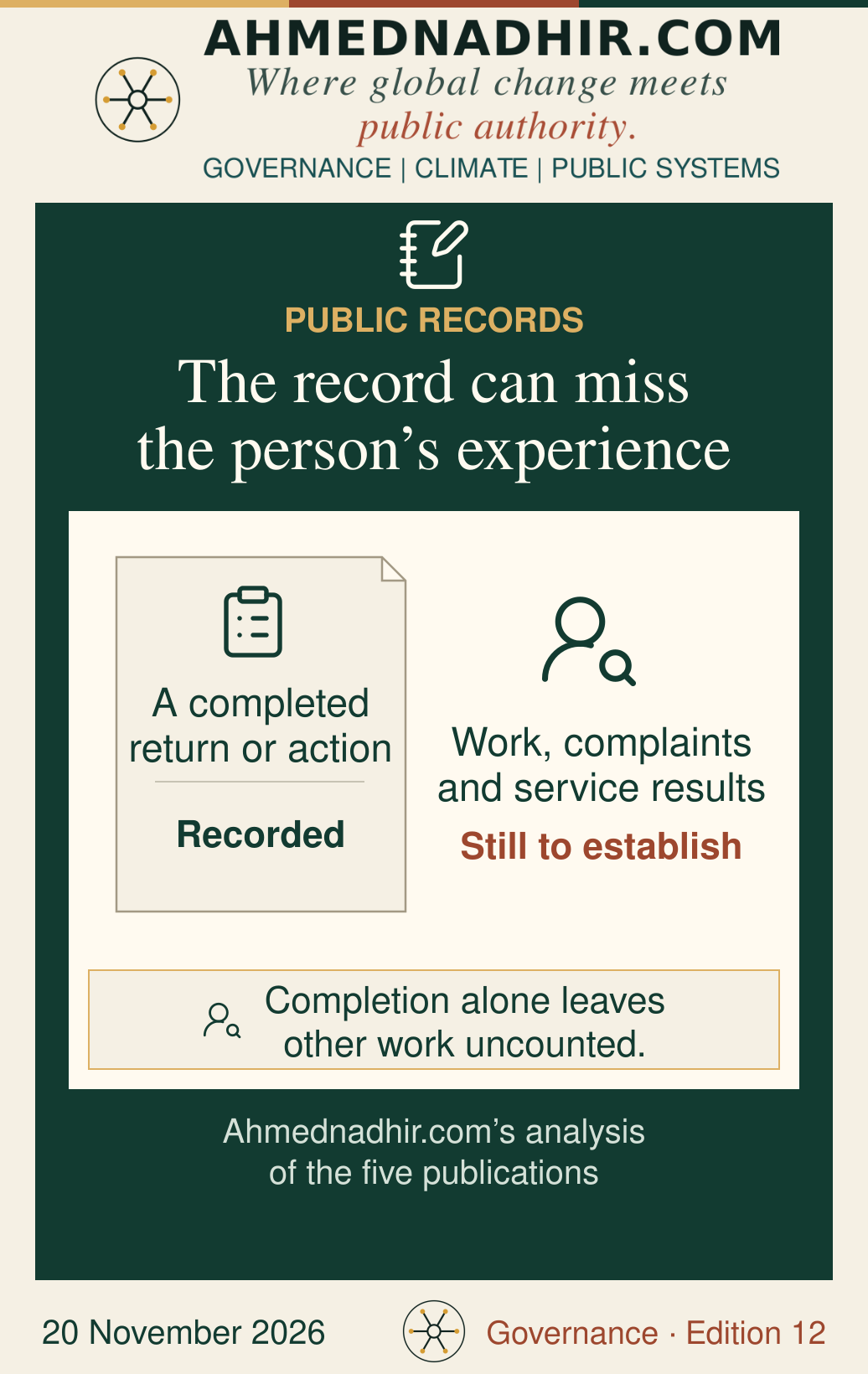
The governing question
A regulator looking only at international news may miss a complaint made in another language. A revenue office counting completed returns may overlook the hours a small trader paid an adviser to spend on the filing. An audit committee can receive a list of completed actions without knowing whether the original failure recurred. These are limitations of particular records, rather than reasons to abandon them. Each becomes more useful when its coverage is understood.
The neighbourhood paper brings the same issue to the street. Residents experience housing, transport and employment support together, while departments may fund and assess them separately. The statistical framework offers a discipline for using those records: a figure needs its definition, source and account of revisions wherever it is reused. These readings do not demonstrate one common effect. They expose a shared responsibility in public judgement: to establish whose experience the evidence captures, where administrative work has moved and what changed after the institution reported completion.
For policy work
Does the evidence include people who use another language, need assistance or abandon the process before they appear in the completed cases?
When a digital reform saves staff time, what happens to the effort required from residents, small firms and the people who help them?
Can the institution distinguish a recommendation accepted, an action completed and a service improvement checked with users?