International research on public decisions and resources
What the official record leaves out
An artificial intelligence (AI) incident can escape an English-language news monitor. A tax return can become quicker to file while taking more effort to understand. An audit recommendation can be marked complete without a service improving. Five new publications examine what public institutions need to see before they claim progress.
In this week’s edition
The five selections were published from 16 to 18 November 2026. They comprise a media analysis, an exploratory tax study, an audit report, a statistical quality framework and a comparative paper on neighbourhood programmes. Their evidence describes different institutions and cannot be combined into a single measure of government performance.
The edition’s central argument
What the complaints dashboard cannot show
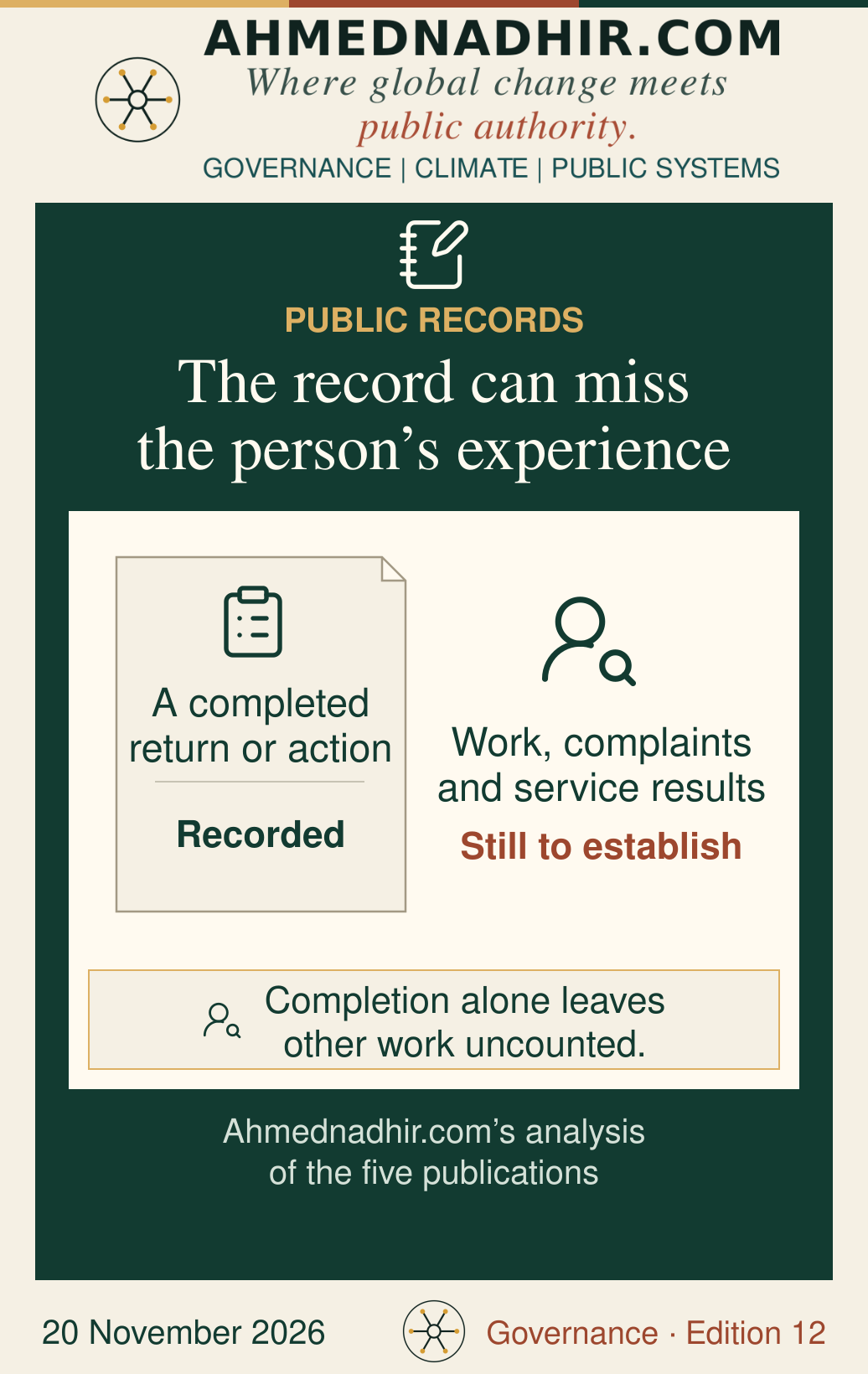
Consider an official reviewing complaints about an automated service. The dashboard shows few incidents. That could mean the service works well. It could also mean that people complain elsewhere, in a language the monitor does not read, or stop trying before a complaint becomes a record. The distinction affects what the official investigates and which failures receive attention.
What the record captures, and what still needs to be established.
AI incidents and public judgement
The language of reporting changes which AI harms become visible
Published by Organisation for Economic Co-operation and Development ·
The Organisation for Economic Co-operation and Development (OECD) uses its AI Incidents and Hazards Monitor to compare German-language coverage with global reporting from June 2023 to February 2026. Across 15 themes, autonomous vehicles, intellectual property and large language models receive greater relative attention in German. Cyberattacks and fraud receive less: 9.9% of the German-language subset, against 15.4% globally.
The governance reading
Kenya
A Kenyan regulator relying on international incident databases could miss complaints carried through Kiswahili reporting or direct service channels. A separate route for resident reports would reveal whether the apparent absence of harm reflects limited coverage.
Global South
Authorities with few analytical staff need access to local-language evidence as well as imported monitoring tools. Sharing classifications across countries can help comparison while preserving the original account and its context.
Wider significance
A global risk agenda can reflect the language and media outlets through which it is assembled. Cross-language comparison is therefore part of scrutiny of the evidence itself.
OECD Table 3, June 2023–February 2026. The comparison concerns coverage, not the population incidence of harm.
Coverage shapes the risks that reach the decision table.
Digital tax administration
Online filing can move work to the taxpayer
Published by Chris Evans, Binh Tran-Nam and Nadia Novik; World Bank Policy Research Working Paper 11501 ·
The authors review academic and institutional literature and examine reported practices in 101 tax jurisdictions through the World Bank’s Business Ready (B-READY) project. They argue that digital systems can ease filing and support compliance while introducing new administrative or regulatory complexity. Some work moves between taxpayers, advisers and the administration. The paper proposes an empirical model for future testing.
The governance reading
Kenya
For Kenya’s revenue administration, a completed electronic return is only one part of the service. Time spent reconciling records, paying for advice or resolving an error belongs in an assessment of the taxpayer’s burden.
Global South
Small firms with limited digital skills may depend on paid intermediaries even when filing is nominally free. Assisted channels and understandable requirements affect who benefits from the reform.
Wider significance
An efficiency claim needs a defined boundary. Savings within an agency can coexist with additional costs outside it, so evaluations need evidence from both sides of the transaction.
Ahmednadhir.com’s illustration of the paper’s argument about where complexity sits.
The workload can move even when the form disappears.
Public audit and institutional learning
An audit action can close while the original problem continues
Published by Organisation for Economic Co-operation and Development ·
The report finds uneven approaches to measuring public audit impact. Many audit bodies track recommendations or financial savings, while fewer assess changes in controls, organisational learning or policy. Its proposed results chain distinguishes the reports auditors produce from changes they influence through management, legislatures and other actors.
The governance reading
Kenya
An audit follow-up can show whether an institution changed the procedure behind a recurrent finding, then examine whether the failure recurred. This keeps administrative closure separate from demonstrated improvement.
Global South
Where audit teams have limited resources, checking a sample of completed actions can be more informative than expanding an unverified list of reported implementation. Managers still need responsibility and resources to act.
Wider significance
Audit independence and honest attribution reinforce each other. An auditor can demonstrate a contribution without claiming exclusive credit for changes made by other institutions.
Ahmednadhir.com’s illustration of the distinction between implementation and verified outcomes.
Implementation and service improvement require separate evidence.
Statistics, data and AI
A published number needs its definition and source
Published by Organisation for Economic Co-operation and Development ·
The revised framework addresses quality across the data lifecycle, including new and secondary sources, advanced analysis and artificial intelligence. It sets out principles and processes for OECD statistics, data and metadata, with continuous improvement as an institutional responsibility. National statistical authorities can use it as a reference alongside good statistical practice.
The governance reading
Kenya
When administrative records become a national indicator, the definition, missing cases and revisions affect how resources are allocated. Statistical producers and service ministries need an agreed account of those changes.
Global South
Reuse of operational or commercial data can reduce collection costs, but it may leave people outside formal systems undercounted. Quality assessment needs to examine coverage before comparing places.
Wider significance
Machine-readable access makes figures easier to reuse. Definitions and revisions must travel with the values so that automation does not turn an uncertain measure into an apparently settled fact.
Ahmednadhir.com’s illustration of why definitions and source information must accompany a reused figure.
A figure is more useful when its origin and limits remain visible.
Neighbourhood services and public funding
Residents live in one neighbourhood while funding arrives in separate streams
Published by Organisation for Economic Co-operation and Development ·
Building on a companion mapping of more than 40 programmes, the paper examines how governments select neighbourhoods, organise funding and connect national strategies with local delivery. Its argument is that additional money works through the arrangements around it, including partnerships, delivery capacity and meaningful participation by residents.
The governance reading
Kenya
A neighbourhood programme can connect national funding with local service responsibilities while leaving the legal mandates intact. Resident experience helps identify whether housing, transport and employment support reach the same people.
Global South
Short project cycles can leave partnerships without continuing staff or operating funds. The relevant design question is who sustains joint work after the initial grant.
Wider significance
Geographical targeting can make disadvantage visible, but selection boundaries also exclude people with similar needs outside the chosen area. Mainstream services remain part of the comparison.
Ahmednadhir.com’s illustration of services meeting in one neighbourhood while funding remains institutionally divided.
A shared address does not give separate institutions a shared budget.
The governing question
The record and the experience
A regulator looking only at international news may miss a complaint made in another language. A revenue office counting completed returns may overlook the hours a small trader paid an adviser to spend on the filing. An audit committee can receive a list of completed actions without knowing whether the original failure recurred. These are limitations of particular records, rather than reasons to abandon them. Each becomes more useful when its coverage is understood.
The neighbourhood paper brings the same issue to the street. Residents experience housing, transport and employment support together, while departments may fund and assess them separately. The statistical framework offers a discipline for using those records: a figure needs its definition, source and account of revisions wherever it is reused. These readings do not demonstrate one common effect. They expose a shared responsibility in public judgement: to establish whose experience the evidence captures, where administrative work has moved and what changed after the institution reported completion.
Reflections for policy work
Three questions to carry into the institution
Whose experience is missing?
Does the evidence include people who use another language, need assistance or abandon the process before they appear in the completed cases?
Where did the work go?
When a digital reform saves staff time, what happens to the effort required from residents, small firms and the people who help them?
What changed after the report?
Can the institution distinguish a recommendation accepted, an action completed and a service improvement checked with users?
Original publications
Sources and publication dates
The research accounts report the publications’ claims. The governance readings, interpretive diagrams and synthesis are Ahmednadhir.com’s analysis. The sources differ in method and reach; their findings do not establish a common measured effect on public services.