
Which decision remains open?
Before committing funds, can the institution explain the problem, compare an AI proposal with other solutions and identify who may reject or change it?
Who Decides What Government Automates?
Five recent publications examine the choices behind public artificial intelligence (AI): which services deserve investment, who scrutinises adoption, how sensitive data travel and whose account of progress reaches the public record.
The five publications examined in this edition were published from 6 to 8 October 2026. None featured in an earlier edition.
United Nations Development Programme: legislators need the expertise to scrutinise artificial intelligence, spending and executive decisions.
Read the finding and its implications →World Bank: affordable applications depend on reliable electricity, connectivity, skills and usable data.
Read the finding and its implications →Organisation for Economic Co-operation and Development: health systems need local evidence before expanding an AI application.
Read the finding and its implications →Organisation for Economic Co-operation and Development: medical-device review and later uses of sensitive data raise different questions.
Read the finding and its implications →United Nations Development Programme: 36 national reviews show frequent consultation but much less parliamentary engagement.
Read the finding and its implications →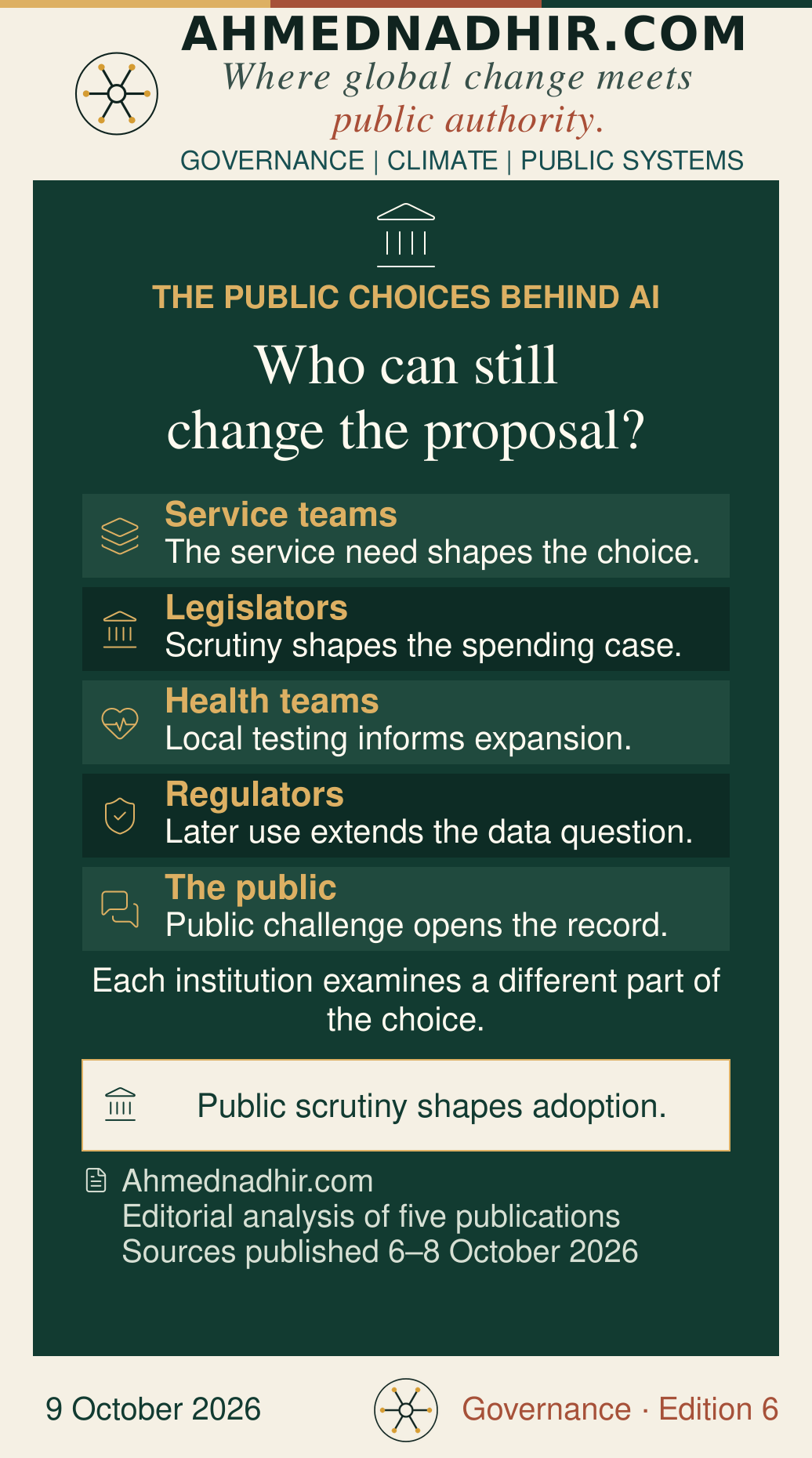
The governing question
This week's publications put the right to judge technology beside the capacity to use it. Sovereignty has an institutional dimension: public bodies need sufficient knowledge and authority to choose an application, set its terms and decide whether it deserves to continue. A locally hosted system does not settle those questions by itself.
The sources are a regional economic assessment, a parliamentary practice paper, conference proceedings, company evidence and a review of national reporting. They offer different forms of evidence; none establishes that an AI programme improved public services.
For policy work
Before committing funds, can the institution explain the problem, compare an AI proposal with other solutions and identify who may reject or change it?
Do legislators, service staff, regulators and affected people have the information and expertise needed to judge the aspects for which each is responsible?
Which results, costs or harms would trigger renewal, modification or withdrawal, and how will the public record show that the institution acted?
The practical discipline is to make the consequential choices visible before they become expensive to reverse, and to preserve the evidence needed to revisit them.