
The finding
Six developments reached different stages
Climate action did not move in a single direction this week. The Intergovernmental Authority on Development (IGAD) Climate Prediction and Applications Centre (ICPAC) produced a forecast. The World Bank Group continued a policy through ordinary operations. Climate Bonds Initiative published comparative research. The Lancet Countdown added a city-health evidence base. Baku hosted an implementation forum. The United States completed one regulatory act and opened another.
- ICPACA seasonal forecast and guidance for eight sectors across the Greater Horn
- World Bank GroupA climate plan carried into ordinary operations and scorecard reporting
- Climate Bonds InitiativeComparative evidence on whether taxonomies enter regulation, incentives and markets
- Lancet CountdownTwenty-eight climate and health indicators developed for European cities
- United Nations (UN) Climate Week, BakuAn implementation programme, but no binding negotiated outcome
- United States Environmental Protection Agency (EPA)A completed partial repeal and a separate proposal concerning the remainder
These facts do not carry equal institutional weight. A seasonal forecast is not a local impact prediction. A climate co-benefit or taxonomy classification is not proof of delivery. A forum programme is not a negotiated outcome. A final repeal and a proposed repeal are different legal acts. This edition reports each development at the stage it actually reached.
Greater Horn
A strong wet signal across the region
ICPAC’s seasonal outlook gives governments and communities a planning condition for the October–December short-rains season. It does not settle local timing, exposure or action.
On 10 September, ICPAC published its Summary for Decision Makers with guidance for agriculture, disaster management, health, livestock, conflict and peace, water, energy and the blue economy. It also directs readers to weekly and monthly forecasts and national meteorological products. Those shorter-range sources will determine when a regional signal becomes a local decision.
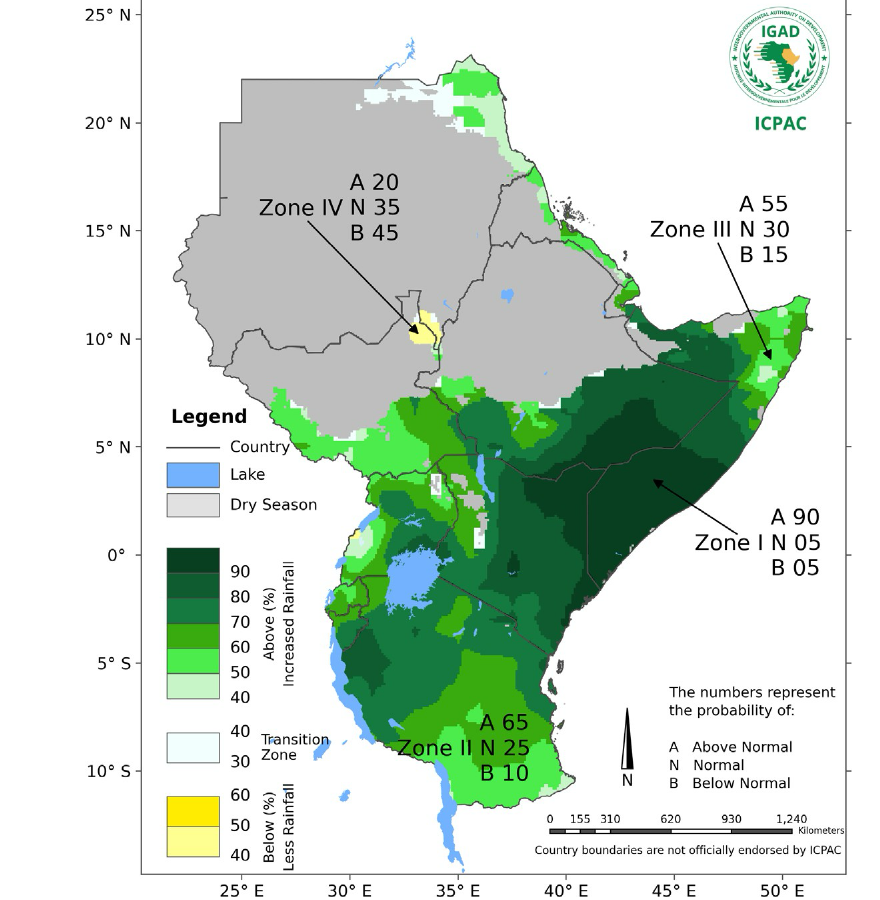
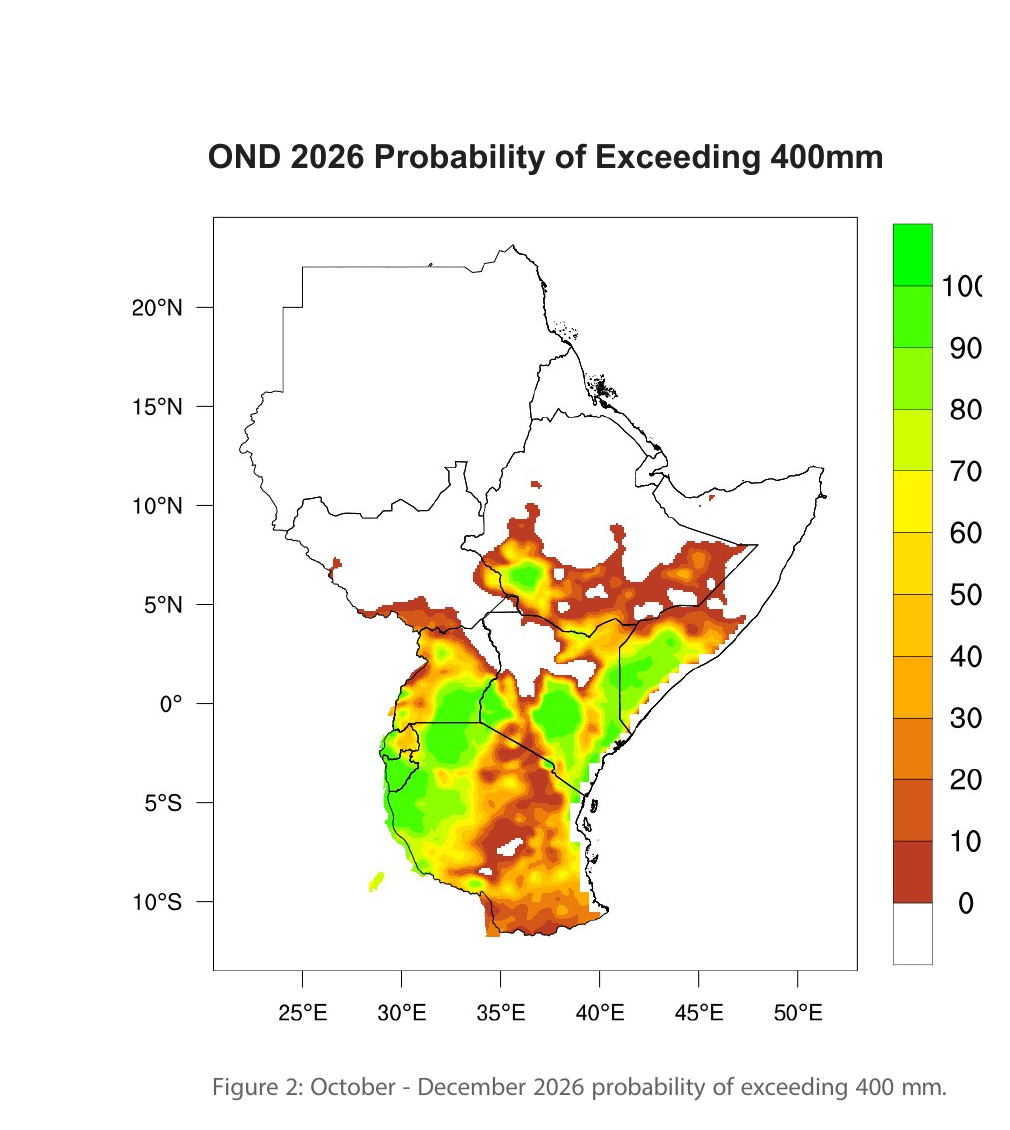
- 90 per cent enhanced rainfallSouthern Ethiopia, central-to-southern Somalia and north-eastern Kenya.
- Greater than 90 per cent probability above 400 mmParts of Somalia, central Kenya, the Lake Victoria basin, Burundi, western Rwanda and western Tanzania.
How to read it. Use the outlook for seasonal planning. Use shorter-range forecasts and impact warnings to decide the timing and location of action.
Kenya
One regional forecast creates four decision fields
Geography, exposure and statutory responsibility determine what follows. One seasonal category cannot settle all four fields.
- North-eastern Kenya
Prepare for flooded roads, unsafe water, livestock disease and interruptions to essential services, while protecting the gains that good rainfall may bring to pasture and water supply.
- Central Kenya
Use shorter-range evidence to guide drainage, slope stability, crop management and storage decisions.
- Lake Victoria basin
Track lake and river levels, urban drainage and public-health warnings through local monitoring.
- National and county roles
National agencies issue forecasts and coordinate major responses. Counties act through health, local water, agriculture, county roads and emergency services.
The practical question is not whether a place sits inside a coloured forecast zone. It is which public authority has to decide, what information it needs next and what service, asset or warning must be ready. The forecast establishes the planning condition; local evidence determines the response.
Climate finance
Commitments entered ordinary operations; delivery remains open
The World Bank keeps its climate plan in force indefinitely
A World Bank Group clarification published on 10 September says climate considerations will continue through operations, knowledge work and Corporate Scorecard reporting. Paris-alignment assessment and Country Climate and Development Reports also continue.
The stated targets cover the twenty-first replenishment of the International Development Association (IDA21), the International Bank for Reconstruction and Development (IBRD) and the International Finance Corporation (IFC).
These commitments establish the policy position. Project documents must still show whether design, finance, procurement or delivery changed.
A 13-country study tests whether taxonomies enter real decisions
Climate Bonds Initiative published Taxonomy Uptake on 14 September. The study compares 13 countries across 46 indicators covering policy integration, market signals, incentives, support, visibility and guidance.
The research was not issued by the governments examined as an official evaluation. Its useful test is whether classification altered regulation, lending terms, incentives, investment or project conditions. Publication alone cannot answer that question.
Climate and health
European city indicators need Kenyan validation
The 2026 Europe Cities Report of the Lancet Countdown was published online on 9 September. Fifty-eight researchers from 31 institutions developed an extensive evidence structure for European cities.
- Heat and wildfire smokeExposure and health burden
- Air quality and infectionEnvironmental conditions linked to health risk
- Green space, mobility and urban formEveryday exposure in the built environment
- Governance and public engagementThe institutions and choices behind city responses
The numerical findings describe Europe. Kenyan cities need measures tied to local exposure, county powers, budgets and data that can be maintained over time. The report offers a structure for that work, not a ready-made African benchmark.
Institutional status
Baku set an agenda. EPA changed legal obligations
UN Climate Week 4 concentrated on implementation
The Baku Implementation Forum programme centred access to finance, public procurement, agrifood finance, implementation tracking, electrification and water. It produced no binding negotiated outcome. The next evidence would be named commitments, responsible institutions, dates, allocated finance and published results.
United States power-plant standards changed in two legally different ways
On 14 September, the EPA completed a partial repeal of 2024 greenhouse-gas requirements and separately proposed withdrawing the remainder.
EPA’s estimate of US$310 billion in savings remains an agency claim. Courts, states, utilities, investors and affected communities will shape the consequences.
Watchlist
Five files to watch next
Each file could materially change the assessment. The relevant evidence is concrete: a forecast update, a commitment, a project record, market use or a legal act.
- Greater Horn rainfall
Weekly and monthly updates, onset forecasts and impact warnings that change the regional assessment or the timing of action.
Likely record holders: Meteorological services, disaster agencies, ministries and counties - Horn preparedness forum
A published commitment that names institutions, dates and allocated finance.
Likely record holders: IGAD, member states, finance ministries and response agencies - World Bank operations
Project evidence showing a change in design, procurement, delivery or results.
Likely record holders: World Bank Group entities and client governments - African taxonomies
Regulatory use, financial incentives and actual issuance, rather than publication alone.
Likely record holders: Central banks, market authorities, treasuries, lenders and issuers - United States power-plant standards
Federal Register publication, court orders and the fate of the separate proposal.
Likely record holders: EPA, courts, states, utilities and affected communities
What this week permits us to say
Climate action moved, but not at one speed
- The Greater Horn outlook establishes a planning condition; shorter-range evidence must determine local action.
- The World Bank and taxonomy sources show institutional intent and classification, not project-level results.
- The European city indicators offer a substantial evidence structure, but Kenyan measures require local validation.
- Baku’s programme and EPA’s legal acts belong in different categories and should be reported that way.
For climate-financed and taxonomy-labelled projects, one concise public project page would make delivery easier to judge: the intended result, place, responsible authority, finance, procurement record, delivery evidence and reporting date. This is not a substitute for scientific evaluation or project appraisal. It is a practical record for claims that would otherwise stop at a label.
Source notes
Principal evidence used in this edition
- ICPAC, Summary for Decision Makers: October to December 2026 Season, 10 September 2026. Official regional forecast and sector guidance.
- ICPAC, Technical Statement from the 74th Greater Horn of Africa Climate Outlook Forum (GHACOF 74), 18 August 2026. Probability methods, onset guidance and territorial detail.
- World Bank Group, Climate Change Action Plan extension: frequently asked questions, 10 September 2026. Policy and stated commitments.
- Climate Bonds Initiative, Taxonomy Uptake, 14 September 2026. Comparative research.
- Chen-Xu and colleagues, 2026 Europe Cities Report of the Lancet Countdown, published online 9 September 2026. Peer-reviewed evidence with European scope.
- United Nations Framework Convention on Climate Change (UNFCCC), Climate Week 4 Implementation Forum programme, 9–10 September 2026. Programme evidence without a binding negotiated outcome.
- EPA, final partial repeal and supplemental proposal for power-plant greenhouse-gas standards, 14 September 2026. Final action and agency claims distinguished from the separate proposal.
- United Nations Environment Programme (UNEP), Limiting Overshoot, 2 September 2026. Late inclusion identified separately from the reporting period.
This edition distinguishes official forecasts, policy statements, peer-reviewed research, forum programmes, proposals and final legal action. Dates refer to the release of each source. The reporting period closed on 15 September 2026, so later outcomes are excluded.