
In this week’s edition
Climate action is being tested after the warning is issued.
Whether forecasts arrive in language, format and time that allow communities to decide.
Whether a farmer has seed, credit, water and authority to follow the advice received.
Whether networks can carry rapid renewable growth while surviving heat, floods and dust.
Whether resilience is written into project design, maintenance and urban administration.
Whether climate risk is recognised in the rules that govern debt and fiscal choices.
Whether poorer tropical countries are protected while the benefits of mitigation take time to arrive.
Overview
The work begins where the forecast ends.
The climate information available to governments, businesses and communities is becoming more detailed. Forecasts are earlier. Risk maps are sharper. Climate targets are more numerous. Yet information protects no one by itself.
Between a forecast and a safer outcome sits an institutional chain. A warning must be translated without losing its scientific meaning. The person receiving it must understand what can happen and what action is possible. Farmers require seed, finance, water and room to change a decision. Electricity networks must remain dependable under the hazards they are helping economies to confront. Cities must place resilience inside ordinary project design and maintenance. Finance ministries must account for climate risk without closing the fiscal space required to reduce it.
A climate service should be judged by the decision it improves, the loss it helps avoid and the people who were able to act in time.
Six readings
From signal to public consequence
Early warning
A warning is unfinished until people know what to do next.
The Intergovernmental Authority on Development Climate Prediction and Applications Centre (ICPAC) HUSIKA platform addresses a familiar break in the early-warning chain. An accurate forecast may be written in technical language, distributed through inaccessible channels or repeated by the media as certainty when it is only probability.
HUSIKA connects authorised climate information with journalists, institutions and communities through digital alerts, social media, audio and translation. Its more important principle is the feedback loop: did the message arrive, was the risk understood, was the required action clear, and could confusion travel back to the institutions responsible?
Agriculture
A forecast without seed, credit or decision-making power cannot protect a harvest.
Digital climate advice can help farmers adjust planting, inputs, water use and harvesting. The Global Center on Adaptation cautions, however, that receiving advice is not the same as being able to follow it.
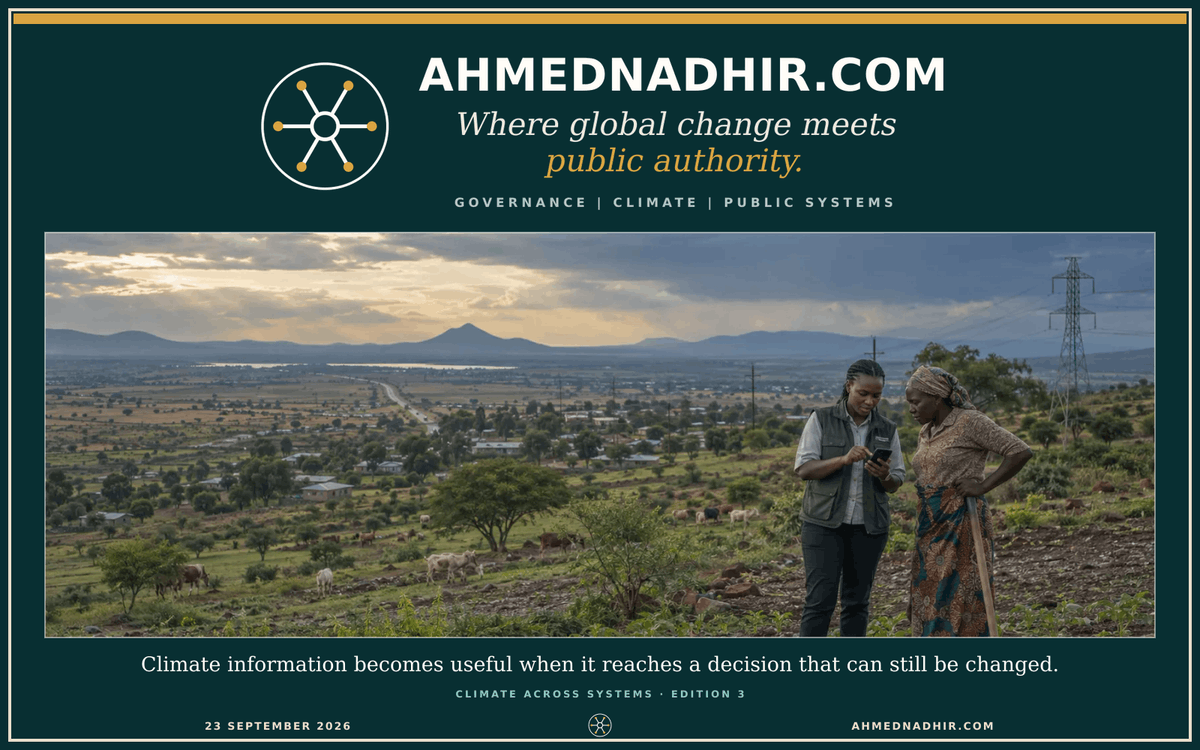
Women farmers may face weaker access to phones, finance, extension services, land, agricultural inputs and household decision-making. A service designed as though every farmer controls the same resources can widen the inequality it was intended to reduce. The practical standard is whether advice is relevant, trusted and connected to the means required for action.
Power systems
Renewable capacity is growing faster than the networks required to carry it.
The world added a record 693 gigawatts of renewable power capacity in 2025. Meeting the global tripling target now requires average additions of about 1.2 terawatts each year between 2026 and 2030. Manufacturing is not the only constraint. Grid congestion, storage, permitting and the cost of finance increasingly decide which projects become usable electricity.
A separate African assessment adds a second test. Transmission and distribution systems must also withstand heat, flooding, wildfire, landslides, sand and dust. Capacity that cannot reach users reliably, or infrastructure that fails under climate pressure, does not complete the transition.
Urban resilience
Kenya is placing climate resilience inside ordinary urban administration.
The second phase of the Kenya Urban Support Programme links climate-adaptive planning to the capacity of urban institutions, the resilience of infrastructure and services, private-sector participation and the transition of refugee camps into integrated host-community and refugee settlements.
Its importance lies in the location of the work. Climate resilience is not presented as a parallel environmental activity. It is being embedded in the institutions that plan, finance, procure, operate and maintain urban services. The measure of progress will be whether that approach survives beyond project preparation and becomes routine public practice.
Public finance
Climate risk is entering the rules that determine how much countries can borrow.
The World Bank Board has endorsed reforms to the joint World Bank and International Monetary Fund Debt Sustainability Framework for Low-Income Countries. The framework influences how debt risks are assessed and, consequently, the financing choices available to governments and lenders.
The revised approach broadens long-term analysis, including development and climate challenges, while giving greater attention to domestic debt and overall public-debt stress. This creates a consequential policy test: climate investment must be recognised as a source of future resilience without allowing optimistic projections to disguise unsustainable borrowing.
Climate equity
Net zero will not immediately reverse the unequal geography of warming.
New modelling reported in Environmental Research Letters finds that poorer tropical regions may be among the last to experience the cooling benefits of a world that reaches net-zero emissions. Their exposure relative to historical climate conditions can persist for decades, even as global averages stabilise.
The finding changes the policy horizon. Faster mitigation remains essential because cumulative emissions determine the scale and duration of future warming. At the same time, countries nearer the equator require durable adaptation, stronger public services and fairer finance now. Climate equity cannot be postponed until the mitigation curve turns.
Synthesis
The institutional chain must hold.
The six readings describe one governing problem at different scales. Climate action fails when any part of the chain is treated as though it were the final result: producing the forecast, sending the message, installing generation, approving the project or labelling finance. Each is necessary. None is sufficient.
Three perspectives
What the evidence asks of institutions
Turn the October to December forecast into named operational decisions.
Counties and national agencies should connect forecast thresholds to drainage clearance, water storage, livestock health, medicine and commodity positioning, road access, emergency referral and public communication. Each trigger needs an institution, a budget line, a deadline and a record of whether action occurred.
Design climate services around the power and resources of the user.
A message delivered to a phone is not evidence that a household, farmer or local authority could respond. Services should be tested against language, device access, gendered control of assets, credit, infrastructure, fiscal space and the legal authority to make a different decision.
Measure the transition by functioning systems, not installed capacity alone.
Renewable additions matter when grids can connect them, storage can balance them and customers receive dependable power. Net zero matters when it arrives early enough to reduce cumulative harm and when the countries facing the longest exposure are financed to adapt throughout the transition.
Reflections
Questions to carry into public work
When a warning is issued, which specific decisions should change, by whom and by what date?
Can the people receiving climate advice obtain the money, inputs, water, transport and authority required to follow it?
Are new power, road, water and health assets being designed for the climate conditions they will actually face?
Do debt and investment assessments recognise the losses avoided by timely adaptation?
What evidence shows that a programme changed an outcome rather than merely distributed information?
How will institutions account for the longer exposure of poorer tropical countries after global emissions reach net zero?
References
Selected publication sources
- Strengthening End-to-End Dissemination and Uptake of Climate Information through HUSIKAICPAC · 23 September 2026 · Greater Horn of Africa climate services
- Best Bets for Gender-Responsive Digital Climate Advisory ServicesGlobal Center on Adaptation · 18 September 2026 · Digital agricultural advisory services
- Delivering on the UAE ConsensusIRENA, COP31 Presidency and Global Renewables Alliance · September 2026
- Climate-resilient transmission and distribution networks in AfricaGlobal Center on Adaptation · 18 September 2026
- Kenya Urban Support Program, Phase IIGlobal Center on Adaptation · 17 September 2026 · Climate-adaptive urban planning
- World Bank Board Endorses Reforms to the Bank-Fund Debt Sustainability FrameworkWorld Bank · 21 September 2026 · Low-income-country debt assessment
- Persistence of inequality in regional warming patterns under net-zero and overshoot pathwaysEnvironmental Research Letters · September 2026 · Global climate-modelling study
Dates refer to the publication of each source. This edition distinguishes official institutional reporting, policy and programme documents, and peer-reviewed research. It does not treat the publication of information as evidence that implementation occurred.