
Executive synthesis
Finance has to arrive within the service window
A US$78 million commitment for the Great Green Wall is this week’s largest new programme-finance announcement in the selected evidence. The next public decision sits with implementing agencies and national authorities: turn a regional promise into funded country actions, recognised land uses and contracts that can be checked.
Elsewhere, the clock is shorter. Kenya’s October rains are approaching forecast onset windows while county requirements, procurement and a new emergency-finance manual sit at different stages. Ghana’s Hohoe relief account reaches a response committee, but does not yet show household distribution. Southern Madagascar is preparing a drought plan. East Africa has validated a strategy, and Algeria and Tunisia have renewed hydrogen cooperation with European partners.
The comparison is about timing and authority. A long-term restoration programme, an emergency consignment and an industrial corridor need different evidence. In each case, the useful question is whether an institution has the money, legal power and operational time to provide the promised benefit. Counting announcements together would conceal precisely what the reader needs to know.
How climate decisions travel through public systems
The relationships below are analytical interpretations. They describe channels and possible feedbacks, not measured effects from these new initiatives.
| Decision field | Direction and transmission | Authority and feedback |
|---|---|---|
| Restoration | Drought and land degradationleads tofood, water and livelihoods | Sustained land care can reinforce recovery. |
| Regional strategy | Climate pressureleads toshared finance and carbon rules | Better access still depends on domestic implementation. |
| October rainfall | Rainfall opportunity and flood riskleads toservices and budgets | Timing determines whether spending protects services. |
| Hohoe flood | River overflowleads todisplacement, housing and health | Unsafe recovery could reproduce exposure. |
| Southern drought | Seasonal riskleads towater, nutrition and livelihoods | Early support could limit escalating need. |
| Hydrogen corridor | Transition demandleads toenergy, water, trade and industry | Export choices affect domestic resource use. |
LAND · FINANCE · LIVELIHOODSBurkina Faso · Chad · Ethiopia · The Gambia · Mali · Mauritania · Niger · Nigeria · Senegal
Great Green Wall finance needs a country-level account of delivery
Programme announced 6 October 2026
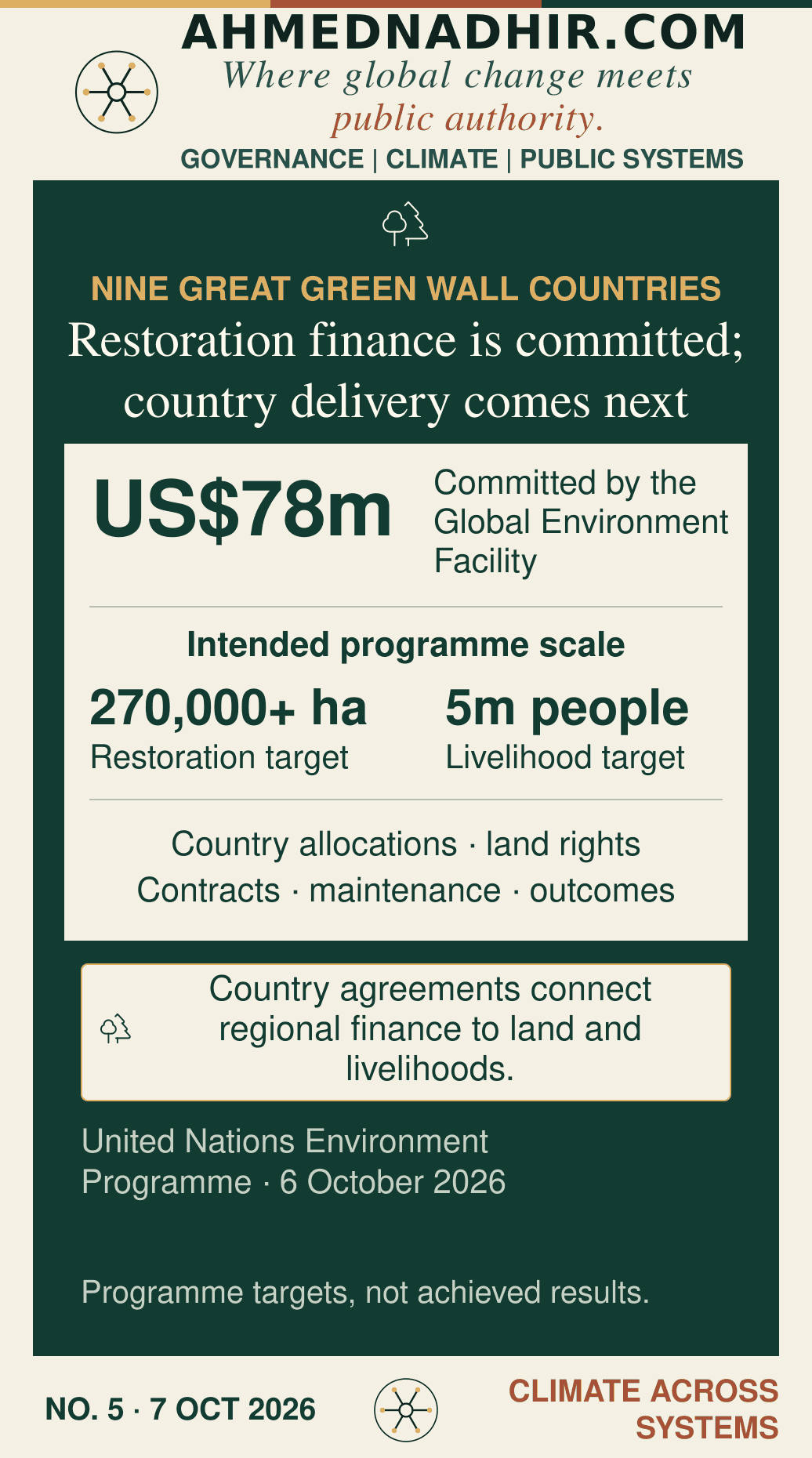
On 6 October, the United Nations Environment Programme announced a US$78 million Global Environment Facility commitment for restoration across nine Great Green Wall countries. It reports co-financing that brings programme resources above US$500 million, with targets exceeding 270,000 hectares and five million people. The Global Environment Facility’s programme record shows approval. These are programme commitments and intended benefits; they are not completed restoration.
The national components differ. Mali’s stated restoration target is 150,000 hectares and Niger’s 55,000. Ethiopia has separate targets for restoration and improved forest management. Eight projects fall to the United Nations Environment Programme and two to the West African Development Bank, working with national authorities and the Pan-African Agency of the Great Green Wall.
For agriculture, pastoralism and water supply, the decisive unit is the landscape and the people using it. Country agreements should identify financing schedules, recognised land uses, implementing agencies and maintenance obligations. Local authorities and customary land users need a route to contest boundaries or benefit claims before work starts. Otherwise a programme can report hectares while leaving the institutions responsible for sustaining them without resources.
The next evidence should connect a funded national component to contracts, agreed sites and a baseline for livelihood and ecological outcomes. The sources reviewed do not establish country disbursements or completed work under this new programme.
REGIONAL GOVERNANCE · CLIMATE FINANCEEast African Community
East Africa has validated a ten-year strategy, but adoption comes next
Regional meeting held 29 September–3 October; release published 5 October 2026
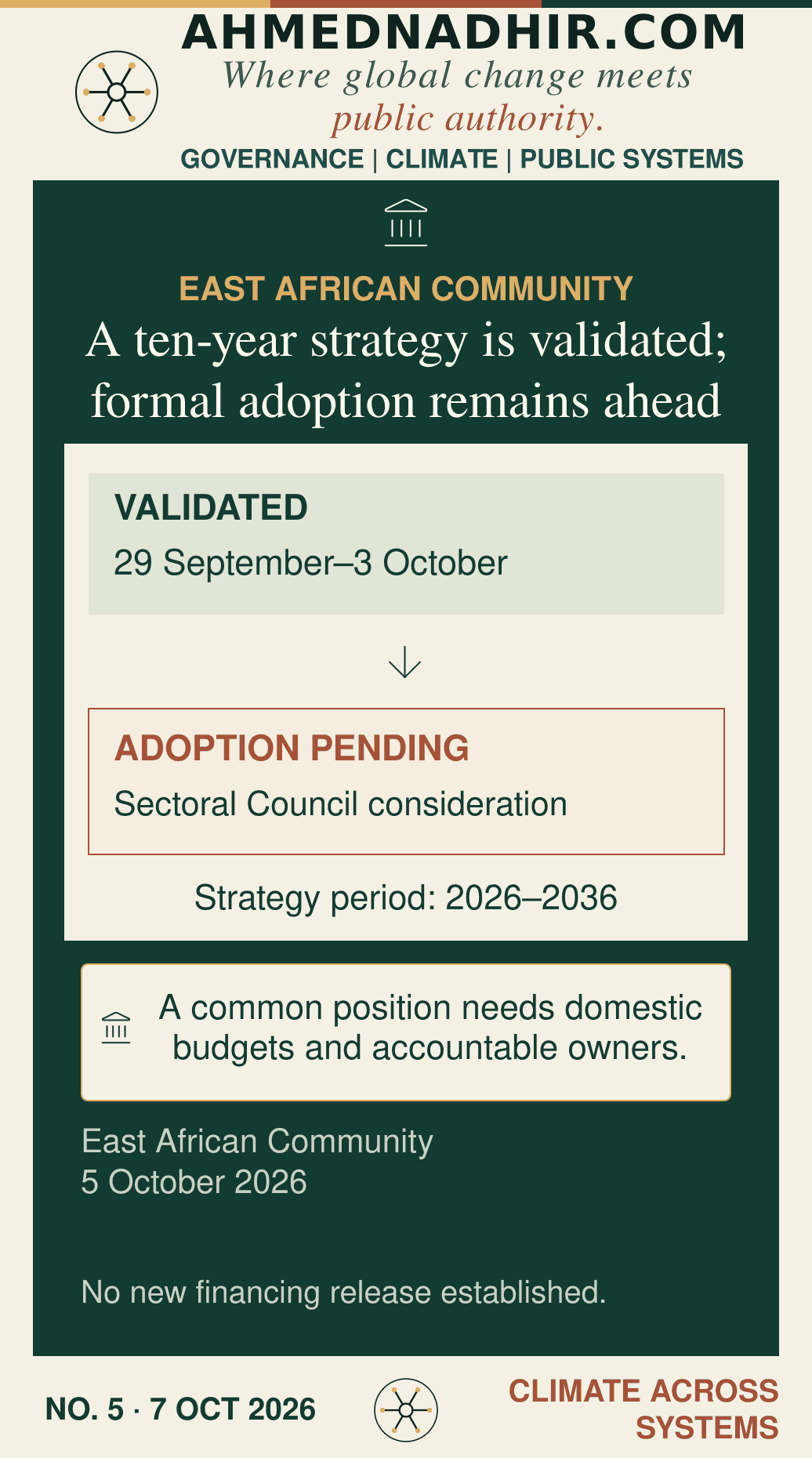
At a meeting held from 29 September to 3 October, East African Community partner states validated a Climate Change Strategy and Action Plan for 2026–2036 and common messages for the next United Nations climate conference. The regional secretariat published the outcome on 5 October. The position seeks more accessible, predictable and grant-based finance, direct access for national institutions, and a tripling of adaptation finance by 2035.
The strategy still goes to the Sectoral Council on Environment and Natural Resources for consideration and adoption. Validation gives negotiators a common position; it does not constitute a domestic appropriation. Finance and sector ministries would still need to translate adopted priorities into their own budget processes. The release supplies no date for the Council’s decision.
The position also seeks harmonised standards for measuring and verifying emissions reductions under the Paris Agreement’s Article 6 cooperation arrangements. This could affect carbon revenues, land rights and benefit-sharing. A regional standard should make national authorisation and local entitlements easier to scrutinise. It cannot substitute for them. An adopted text, costed implementation plan and allocation of responsibilities would be the next consequential evidence.
FORECAST · COUNTY FINANCE · PROCUREMENTKenya · Makueni County · Wajir County
Kenya’s rainfall window meets a new emergency-finance framework
Forecast issued 30 September; Makueni notice 1 October; national manual published 6 October 2026
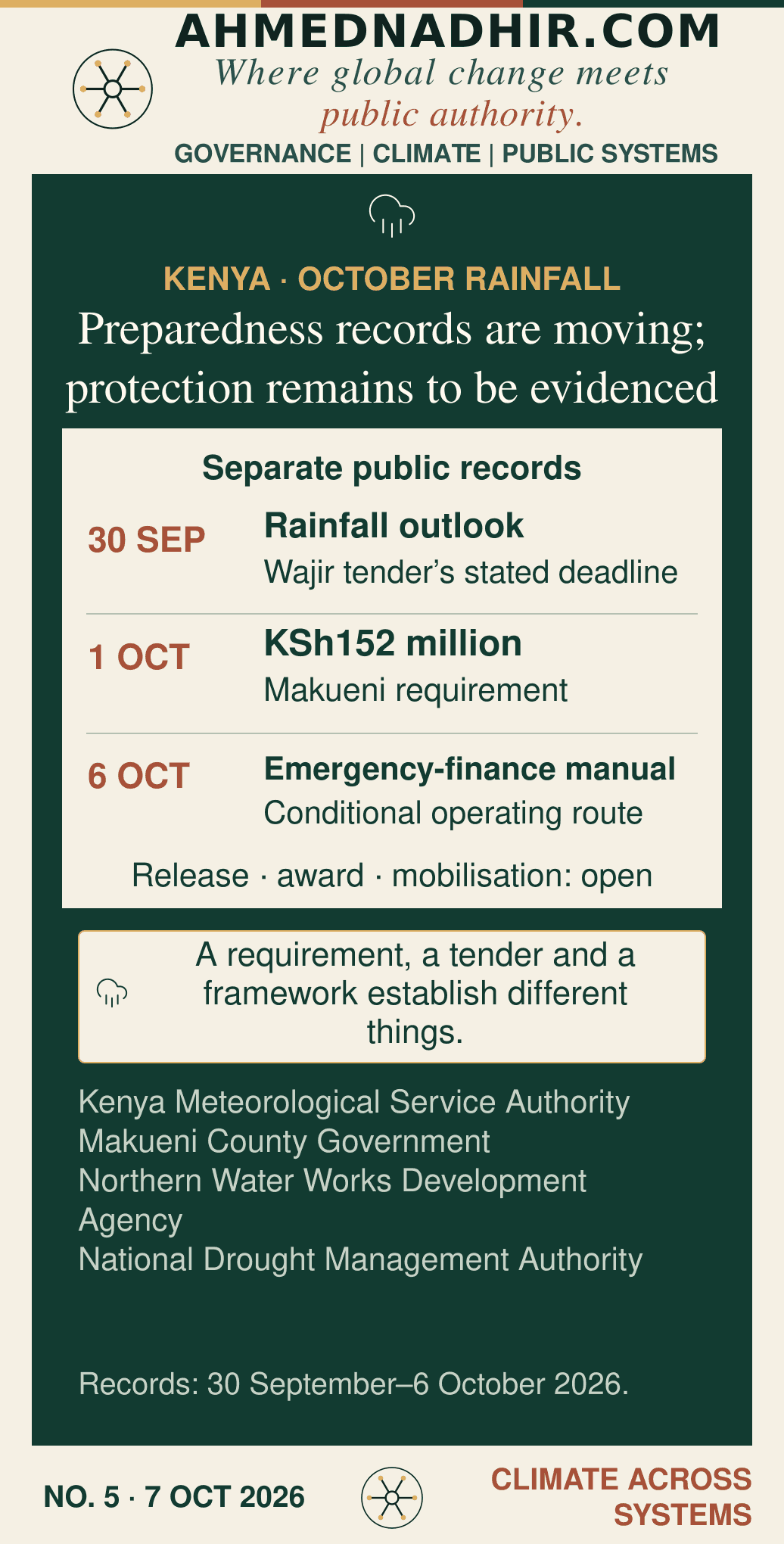
The Kenya Meteorological Service Authority’s 30 September outlook places rainfall onset in Marsabit, Mandera, Wajir, Garissa and Isiolo in the first to second week of October. Makueni’s onset window is later, in the second to third week. Above-average rain can support planting, pasture and water storage, while intense events can interrupt roads, sanitation and health services. These are forecasts, not observations of damage.
Makueni County Government’s 1 October account of its previous day’s preparedness conference puts the requirement at KSh152 million. It does not establish a voted allocation or release. A national agency, the Northern Water Works Development Agency, advertised Masalale–Kilkey flood-control works in Wajir with a stated closing date of 30 September. The notice reports funds for water projects, but supplies no contract award or completed works record.
A further change arrived on 6 October when the National Drought Management Authority published the Kenya Contingent Emergency Response Project operations manual. It sets out a conditional route to repurpose eligible undisbursed World Bank portfolio balances. Publication of that framework does not activate the project or release money. The National Treasury would own the activation request; the government’s crisis plan and World Bank acceptance remain necessary steps.
The practical question is whether each responsible authority can complete its financing and procurement decisions before the service is needed. Forecast updates, Makueni budget authority, Wajir award and mobilisation records, and any emergency-project activation would alter the assessment. No release or completed protection is established by these particular records.
FLOOD IMPACT · RELIEF · RECOVERYHohoe Municipality · Volta Region · Ghana
Hohoe’s relief handover leaves household distribution to be accounted for
Presidency response account published 2 October 2026
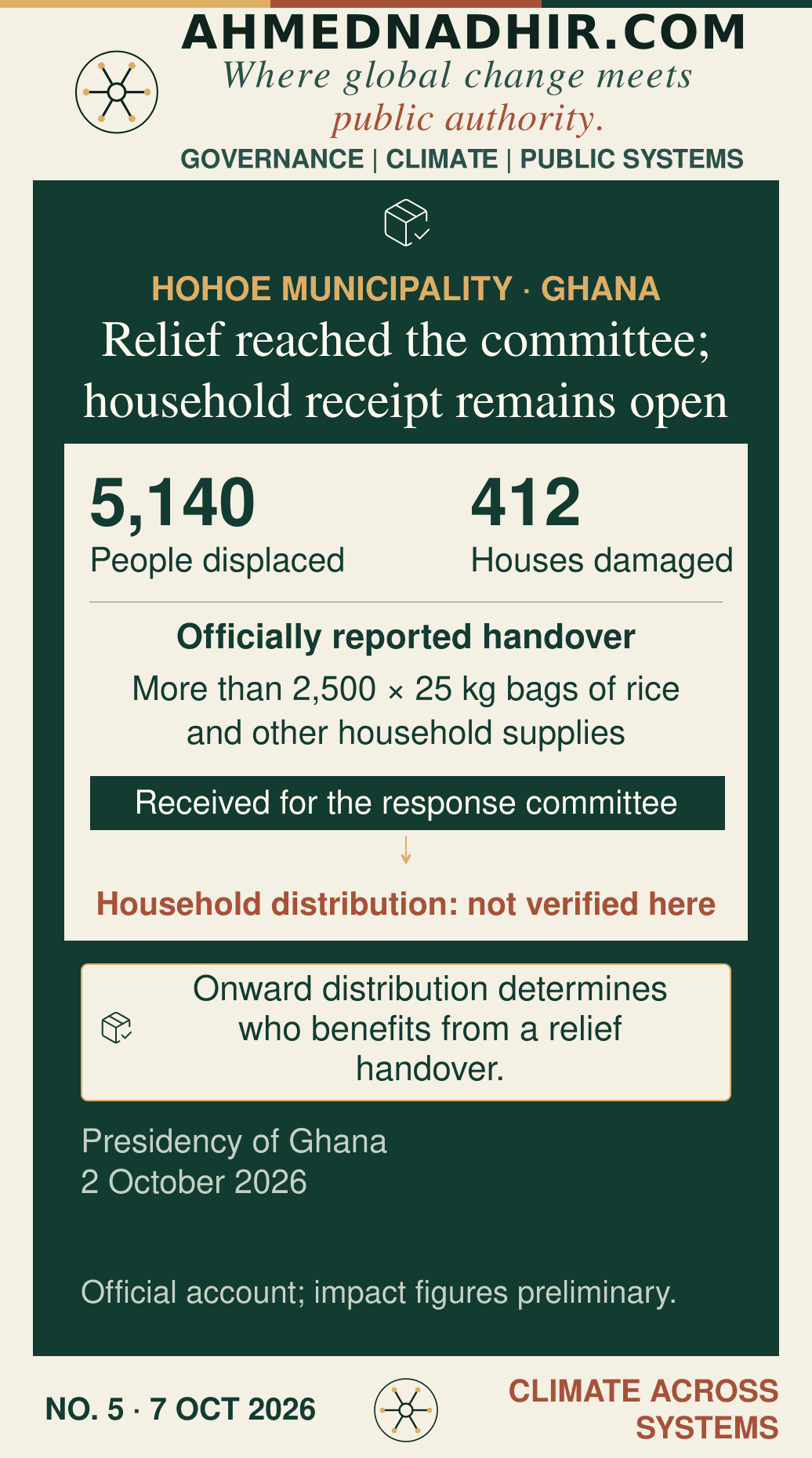
Ghana’s Presidency reported preliminary National Disaster Management Organisation figures of 5,140 displaced residents and 412 damaged houses in Hohoe Municipality, Volta Region. Its 2 October account links the Dayi River’s overflow to sustained rainfall in neighbouring Togo. This is an official impact account, not an attribution study establishing how climate change affected this particular flood.
The Presidency names the recipient of a relief consignment: the regional minister received it on behalf of a post-flood committee. The inventory includes more than 2,500 bags of rice of 25 kilograms each, mattresses, mats, food and household supplies. This establishes an officially reported handover into the response chain. It does not establish how many households subsequently received supplies. A reported private cement donation for distribution is another stage again.
The municipal assembly, regional administration, disaster agency and response committee have different parts in relief and recovery. Distribution totals, anonymised coverage data, building-safety assessments and a public expenditure account would show how supplies and reconstruction support reached people. Household names and vulnerability records should remain protected. The sources reviewed do not establish a Hohoe-specific public spending total, completed reconstruction or a recovery outcome.
DROUGHT · ANTICIPATORY ACTIONSouthern Madagascar
Southern Madagascar is preparing a common drought action plan
National disaster-management update published 4 October 2026
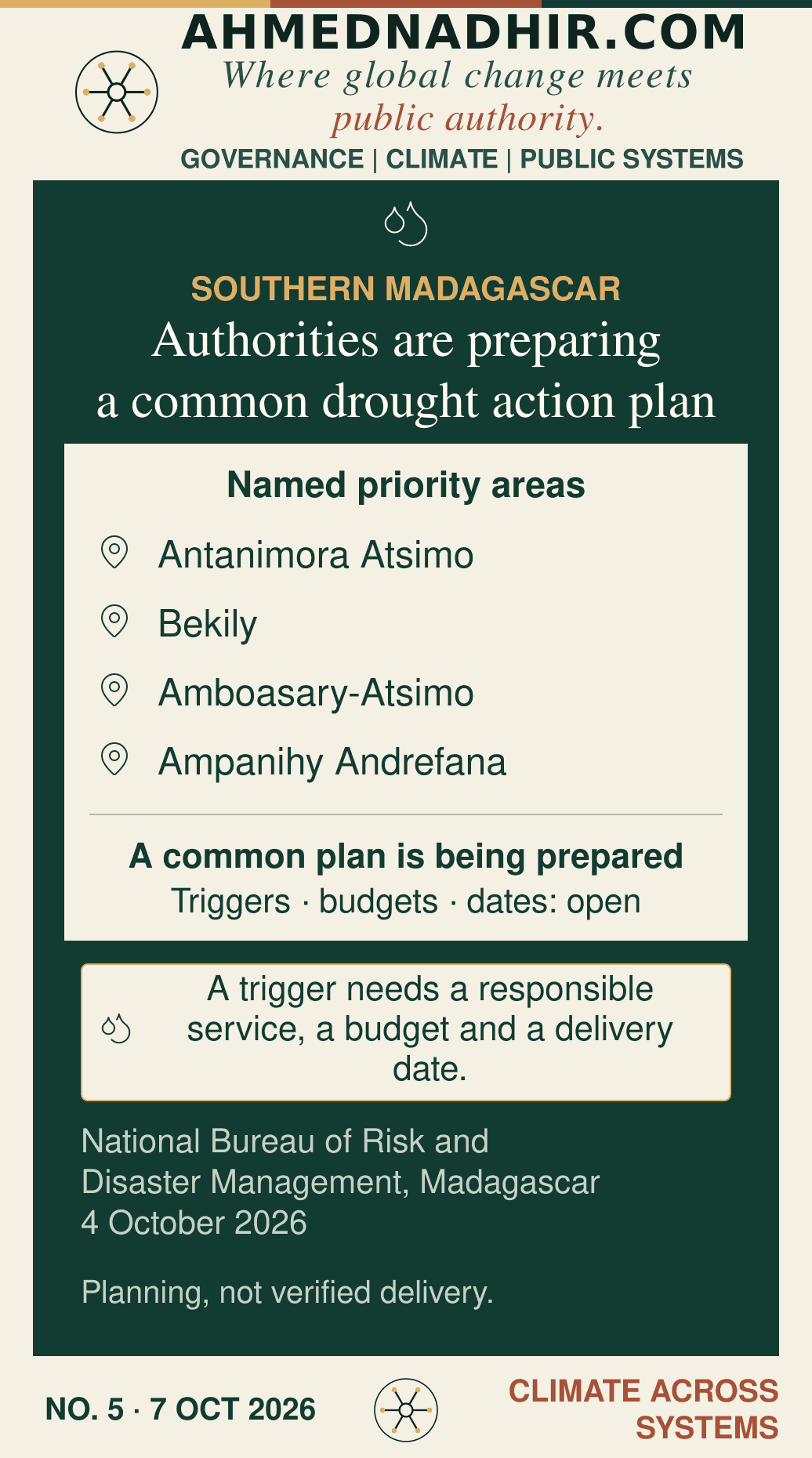
Madagascar’s National Bureau of Risk and Disaster Management reported on 4 October that authorities and partners were coordinating anticipatory drought action in the south. Its priority list names Antanimora Atsimo, Bekily, Amboasary-Atsimo and Ampanihy Andrefana. The names are retained as the bureau’s priority areas; this edition does not convert them into district boundaries.
Meetings and workshops are intended to produce a common action plan, drawing on earlier anticipatory work and warning and food-security information. Météo Madagascar’s seasonal outlook provides context: below-normal early-season rainfall is forecast in parts of the south and south-west. A seasonal rainfall category is not a household food-security outcome or a funding trigger by itself.
The disaster bureau and participating sector authorities now need to identify the threshold for each intervention, the competent district or commune, a financing source and delivery dates. Water supply, nutrition, livestock support and social protection have different lead times. The public bulletin establishes coordination, not an adopted plan, release or completed anticipatory delivery. Local assignments and the final plan would make the institutional chain assessable.
ENERGY TRANSITION · TRADE · INDUSTRIAL POLICYAlgeria · Tunisia · Italy · Austria · Germany
The hydrogen corridor has renewed political support, not an investment decision
Second ministerial meeting concluded 1 October; report published 2 October 2026
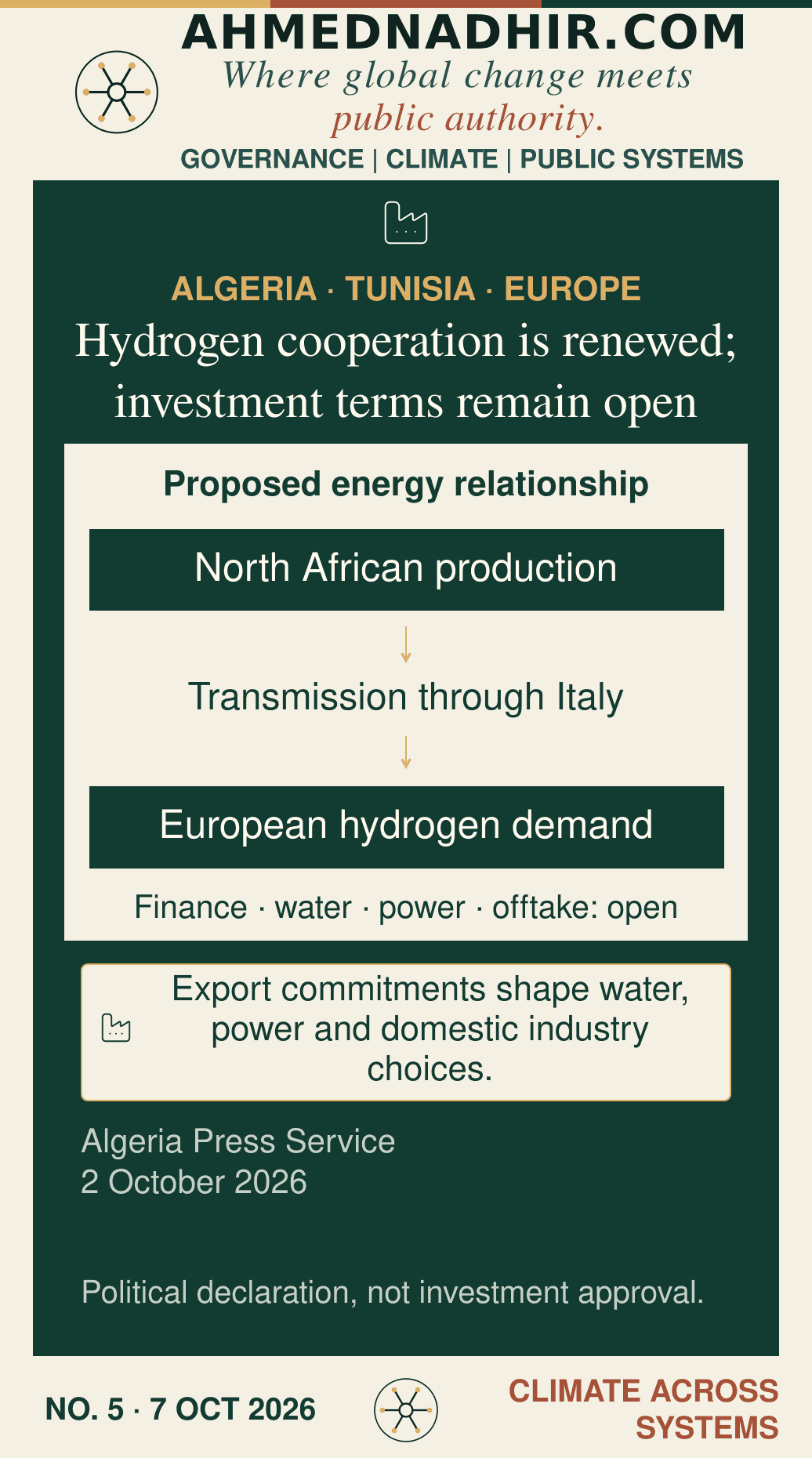
Algeria Press Service reported on 2 October that ministers from Algeria, Tunisia, Italy, Austria and Germany had concluded a meeting in Algiers the previous day with a declaration of political intent for the Southern Hydrogen Corridor. The proposed connection would link North African renewable-hydrogen production to European demand. The corridor’s promoters envisage extensive reuse of existing gas infrastructure.
For Algeria and Tunisia, the consequential decisions concern electricity and water allocation, industrial development and the distribution of investment risk. Reusing a pipe does not settle the cost of producing hydrogen, the treatment of water, electricity-system needs or the price a buyer will guarantee. National energy institutions and regulators retain those choices; permitting and affected local communities cannot be replaced by a regional declaration.
This week’s public record renews cooperation. It does not establish a final investment decision, binding offtake, project finance or local environmental permissions. Contracts and regulatory documents would show whether export earnings support domestic capabilities and who bears demand or construction risk. European purchase commitments matter to African choices because they can change what projects are financeable, while long-term export obligations may constrain future domestic use.
Territorial evidence
The places and institutions this edition can account for
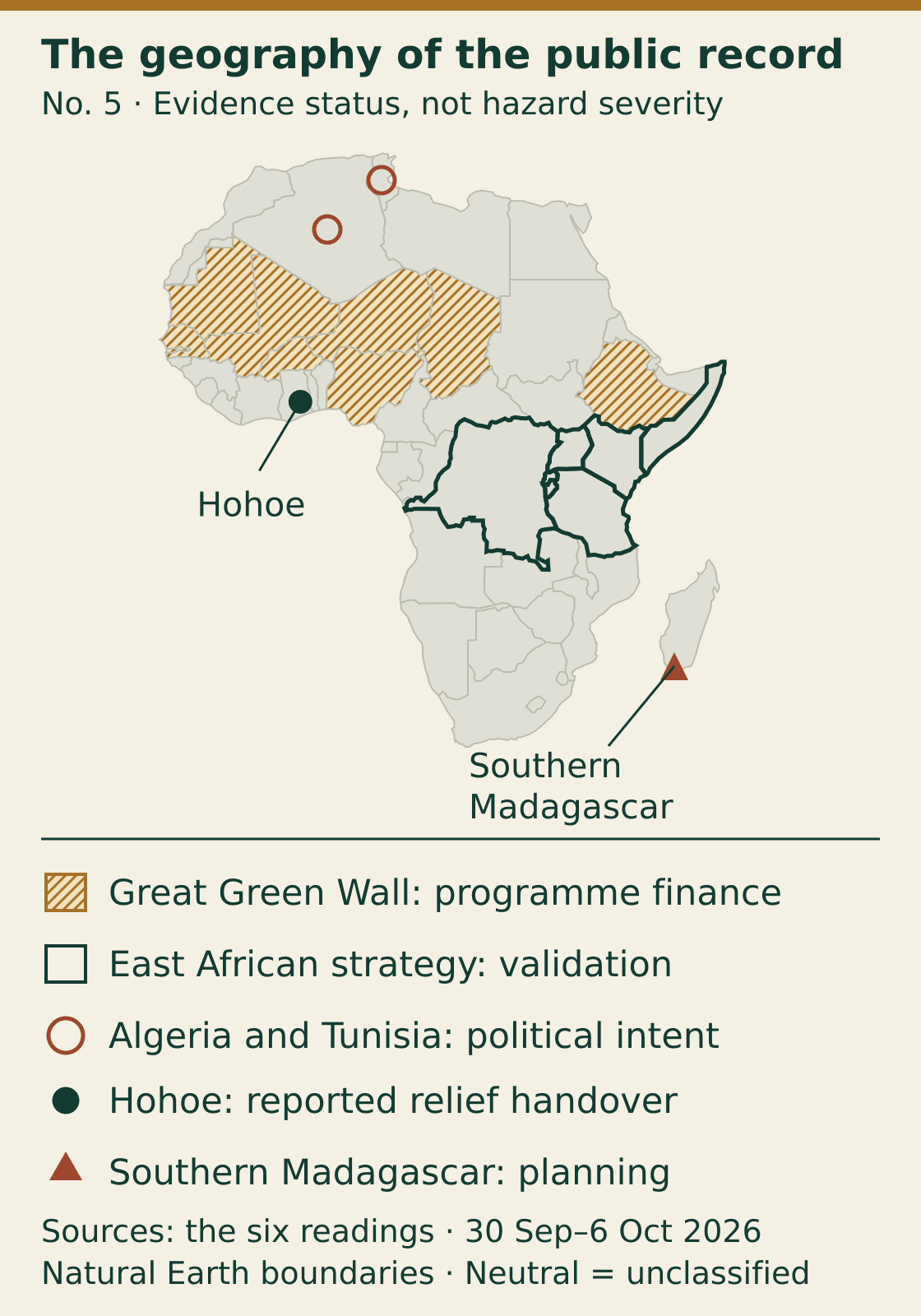
Read the same territorial evidence as text
| Record | Geography supported | Evidence and limit |
|---|---|---|
| Great Green Wall programme | Burkina Faso, Chad, Ethiopia, The Gambia, Mali, Mauritania, Niger, Nigeria and Senegal | Programme finance commitment. National disbursements and delivery remain open. |
| East African Community strategy | Burundi, Democratic Republic of the Congo, Kenya, Rwanda, Somalia, South Sudan, Tanzania and Uganda | Regional validation. Domestic adoption, financing and execution are not inferred from membership. |
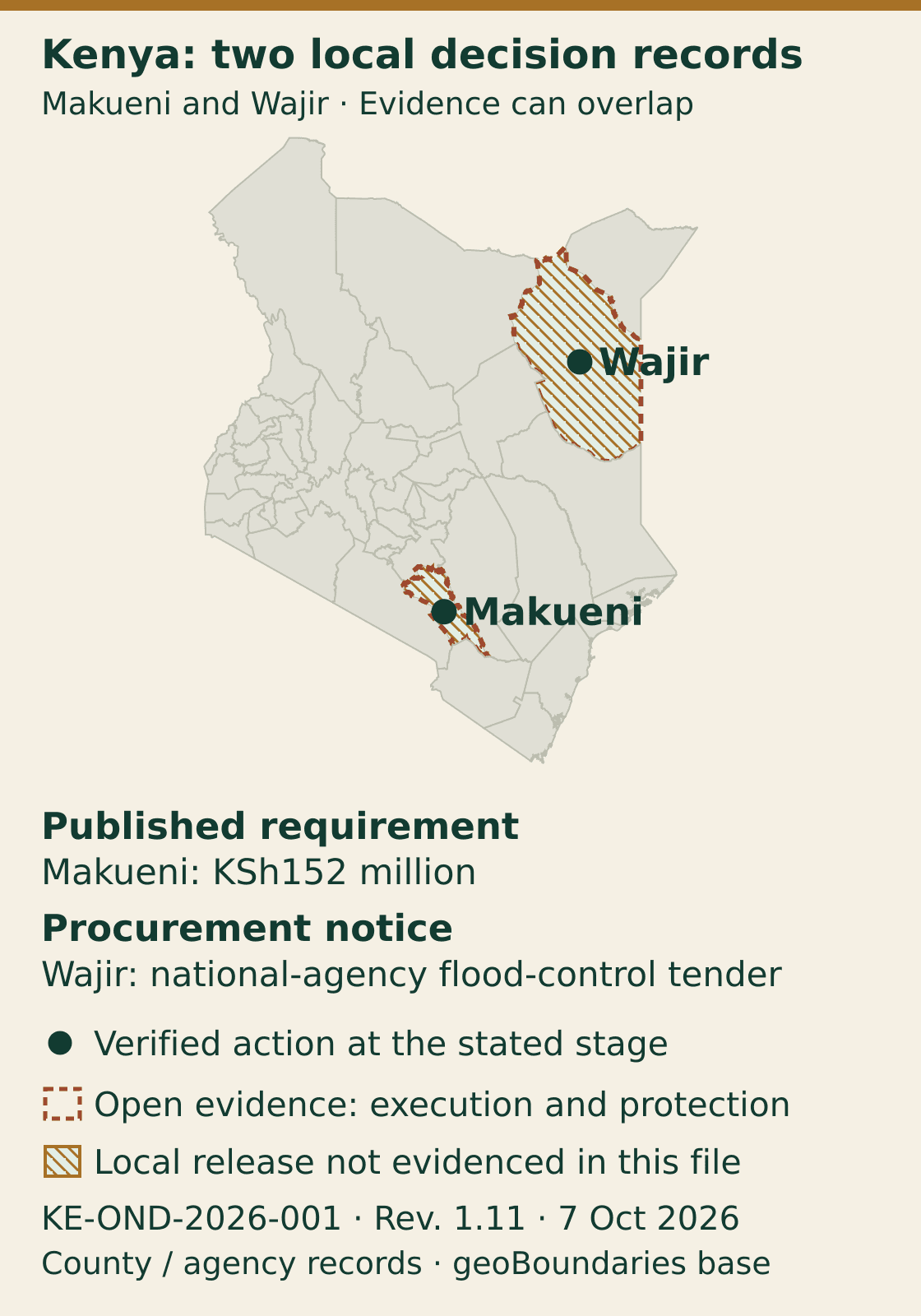
| Kenyan county evidence | Makueni and Wajir | A preparedness requirement and a national-agency tender respectively. Awards, local releases and completed protection are not established in these records. |
| Relief response | Hohoe Municipality, Volta Region, Ghana | Officially reported handover to the response committee; household receipt and recovery outcomes remain open. |
| Drought planning | Southern Madagascar: the bureau names Antanimora Atsimo, Bekily, Amboasary-Atsimo and Ampanihy Andrefana | Coordination towards a plan. No district boundaries or completed delivery are inferred. |
| Hydrogen cooperation | Algeria and Tunisia | Political declaration with European partners. Project finance, permissions and binding purchases remain open. |
The continental consequences differ. Great Green Wall countries face land-use and maintenance choices within nationally implemented components. East African Community members are negotiating shared rules that still require domestic decisions. Hohoe’s river exposure crosses a border, while its immediate relief chain is municipal and regional. Southern Madagascar needs local assignments before a common drought plan becomes operational. Algeria and Tunisia face long-lived industrial and resource-allocation choices tied to European demand.
Kenya in this week’s field
Kenya’s specific task is nearer-term: northern and north-eastern onset guidance is earlier than Makueni’s. County preparedness, the national agency’s Wajir works and a possible Treasury-led emergency-finance request must be assessed separately. One county’s requirement or a national manual cannot stand for readiness across Kenya’s arid and semi-arid lands.
Follow the dated Kenya decision trace and its open evidence.
Nexus Deep Dive · Informed interpretation
The cost of acting after the useful moment
The strongest comparison is between the Great Green Wall’s long programme horizon and the short interval between a forecast and local protection in Kenya. Both need finance to reach a defined place. Yet a restoration contract can sequence work across seasons, whereas an evacuation route, water treatment stock or drainage repair may lose much of its value if it arrives after the dangerous rainfall. The same amount of expenditure can therefore produce very different protection depending on its timing.
This is why a financing label is insufficient. A programme commitment establishes a resource envelope; a county requirement establishes a need; a procurement notice opens a competition. The useful measure is whether the next authorised step can finish within the service window. Before rain, authorities can check stores, staff rosters, access routes and equipment that already exist while following the legal process for additional purchases. An emergency label should not erase the distinction between these operational steps.
Kenya’s proposed use of undisbursed World Bank balances adds an opportunity cost. Repurposing could accelerate an emergency response, but the public should be able to identify the original activities whose financing changes. The Treasury and implementing ministries need an account of both the emergency benefit and the revised development programme. This is an analytical implication of the financing mechanism, not evidence that transfers have occurred.
Hohoe tests the other end of the chain. A named committee can receive supplies without every intended household receiving an adequate share. The record needs to continue through allocation, delivery and complaint resolution. It should disclose aggregate coverage and criteria, while protecting names and sensitive household circumstances. A distribution system that is quick but opaque can overlook renters, displaced people and those without the paperwork used to establish eligibility.
Restoration extends the same issue across years: a paid contractor may complete planting while no institution is funded to protect the resulting landscape. Remote observations can help assess vegetation, but cannot alone establish consent, income gains or maintenance responsibility. Communities produce indispensable evidence about access and livelihoods; programme contracts should preserve their ability to challenge official results.
The institutional improvement is a service-specific account of time, authority and continuing cost. It would let a legislature or auditor distinguish money available from protection achieved, and ask who must act next. Regional institutions can make these accounts comparable without pretending that a Kenyan county, a Ghanaian municipality and a Malagasy commune hold identical powers.
Forward watchlist
The next document that would change the assessment
| Decision | Known timing | Evidence to watch |
|---|---|---|
| Great Green Wall | Next country agreements; dates not announced | Allocations, land agreements and first contracts would establish where the commitment becomes executable. |
| East African strategy | Next Sectoral Council consideration; date not stated | An adopted, costed plan would change the assessment from validation to implementation authority. |
| Kenya | First–third weeks of October, by forecast area | Updated forecasts, budget authority, award and mobilisation records; any emergency-project activation and financing. |
| Hohoe | Immediate relief and subsequent recovery | Aggregate household receipt, expenditure and safety inspections would connect handover to protection. |
| Southern Madagascar | When the common plan is finalised; date not stated | Triggers, responsible local administrations and funded delivery dates would make anticipation testable. |
| Hydrogen corridor | Next investment and permitting milestones; dates not fixed | Binding purchases, finance terms, water and power assessments, and domestic-benefit obligations. |
Future Build · A proposition
A service commitment that survives the announcement
A practical next build would be a traceable service commitment inside existing public contracts and budget reports. Start with one restoration component and one pre-season preparedness service. Each would carry a durable action identifier linking the signal, responsible authority, budget authority, actual payments, contracted work, place served, maintenance owner and evidence of benefit. This is a proposition for implementation, not a prediction of government adoption.
National finance and sector institutions would own the records under their existing budget, procurement and audit arrangements. Local authorities would confirm the services for which they are competent. Any new mandatory disclosure would require the relevant domestic legal review; a regional specification cannot create that power. Programme administration budgets and existing information systems should cover the small reporting cost, rather than a separate fund or parallel platform.
Within 100 days, two willing implementing units could select the services, check disclosure powers, publish a baseline and reconcile their first expenditure and delivery records. Each pilot should name an auditor or review office, test one correction route and invite affected communities to challenge an inaccurate entry. Success means the two records can be followed from authority to payment to service without relying on an announcement.
Use existing document repositories and simple downloadable tables, with common identifiers and version histories. Publish aggregate household coverage and protect personal records. Remote sensing can supplement a restoration baseline; local knowledge should determine whether access and livelihood benefits are real. Neither technology should replace inspection or a right to contest the account.
Within three years, participating audit institutions could test sampled actions across budget cycles, including maintenance and changed project allocations. By 2035, the ambition is routine comparability across participating African systems, retaining their own legal duties. The trade-off is administrative burden: limit the fields to decisions people can use, fund the staff who reconcile them, and drop duplicative reporting. A neat record should never be accepted as proof of a completed service.
Sources and scope
The evidence behind the six readings
Official records establish different stages of action. The comparative argument and Future Build are independent analysis. “Not established” refers to the sources reviewed; it is not proof that no action occurred. Forecasts do not establish impacts, and official impact accounts do not by themselves attribute an event to climate change.
- United Nations Environment Programme, Great Green Wall programme, 6 October 2026
- Global Environment Facility, TALSIG programme record
- East African Community, climate-finance position and strategy validation, 5 October 2026
- Kenya Meteorological Service Authority, October 2026 forecast, issued 30 September 2026
- Makueni County Government, preparedness requirement, 1 October 2026
- Northern Water Works Development Agency, Wajir flood-control tender
- National Drought Management Authority · Kenya emergency-response operations manual, published 6 October 2026
- World Bank · Kenya Contingent Emergency Response Project, appraisal environmental and social review, 2 October 2026
- Presidency of Ghana, Hohoe flood response, 2 October 2026
- Madagascar National Bureau of Risk and Disaster Management, southern drought planning, 4 October 2026
- Météo Madagascar · seasonal outlook, October 2026–April 2027
- Algeria Press Service, second SoutH2 ministerial meeting, 2 October 2026
- SoutH2 Corridor project information
The continental selection considered North Africa, West Africa and the Sahel, Central, East, Southern and Indian Ocean Africa. It is a selected source review, not an audit of every African jurisdiction. The six readings are admitted for a consequential record within 30 September–6 October 2026.
Map bases: Natural Earth, public domain; geoBoundaries, Kenya administrative level 1. Symbols describe the cited records, not coverage of a programme’s implementation.
Suggested citation: Ahmed Nadhir Omar, ‘A forecast, a budget and the evidence of action’, Climate Across Systems, Edition 5, 7 October 2026, version 1.0. Reporting period: 30 September–6 October 2026.