
Overview
Climate commitments take shape in ordinary public decisions
- A restored forest has a boundary and a person with a claim to it.
- A weather warning begins with a dependable observation.
- A lower-carbon building starts with a material specification an engineer can verify.
- Decisions in different offices determine whether a climate commitment changes a place.
This week’s five readings connect a new assessment from the Food and Agriculture Organization of the United Nations (FAO) and guidance from the World Meteorological Organization (WMO) and International Telecommunication Union (ITU) to Kenyan food recovery, an expanding African cement coalition and proposed investment in the Zambezi basin. The opportunity is to put clear rights, dependable data and accountable purchasing behind the ambition.
Forests, land and rightsKenya · Africa · Global systems
Restoration begins with the people who use the land
Food and Agriculture Organization report published 28 September 2026
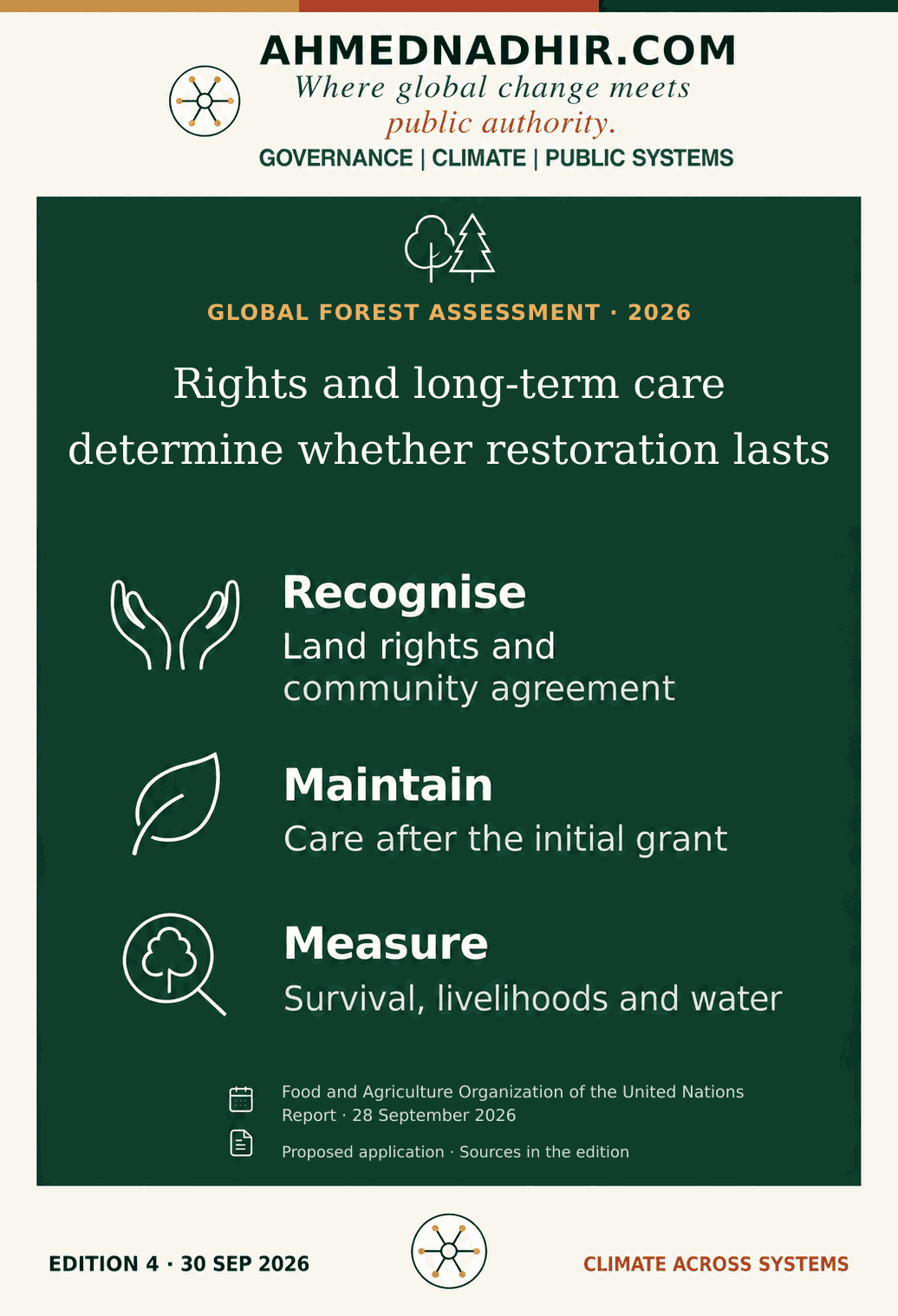
The Food and Agriculture Organization of the United Nations (FAO) published The State of the World’s Forests 2026 on 28 September. Its assessment estimates that 489 million hectares of forest were lost to deforestation during 1990–2025 and that more than 460 million hectares of forest are degraded. These are global estimates across different periods and measures. They describe the scale of the problem, not a forecast of what a particular African landscape will deliver.
FAO identifies four routes to more durable restoration: strengthen people’s rights; plan across a landscape rather than a single plot; finance the long term; and align laws and institutions. That sequence matters where tree planting competes with grazing, farming, housing and water access. Counting seedlings is a poor account of a restored livelihood if the rights of the people who care for the land are unsettled.
Kenyan and other African land, forestry and county authorities can use the report to ask a concrete question of each programme: whose use of the land is recognised, who benefits from the restored area, and who maintains it after the grant period? A mapped baseline should distinguish degraded forest from other land. Public records can then track survival, soil and water outcomes, livelihood effects and grievances over several seasons.
Community consent and local knowledge belong at the design stage, before a parcel is counted as a future gain.
FAO’s pledged-restoration and current-restoration totals cover different populations. They cannot be used to calculate a pledge gap. Site-level completion and quality need separate evidence.
Weather data and resilienceKenya · International observation systems
The forecast depends on protected frequencies
World Meteorological Organization–International Telecommunication Union handbook released 28 September 2026
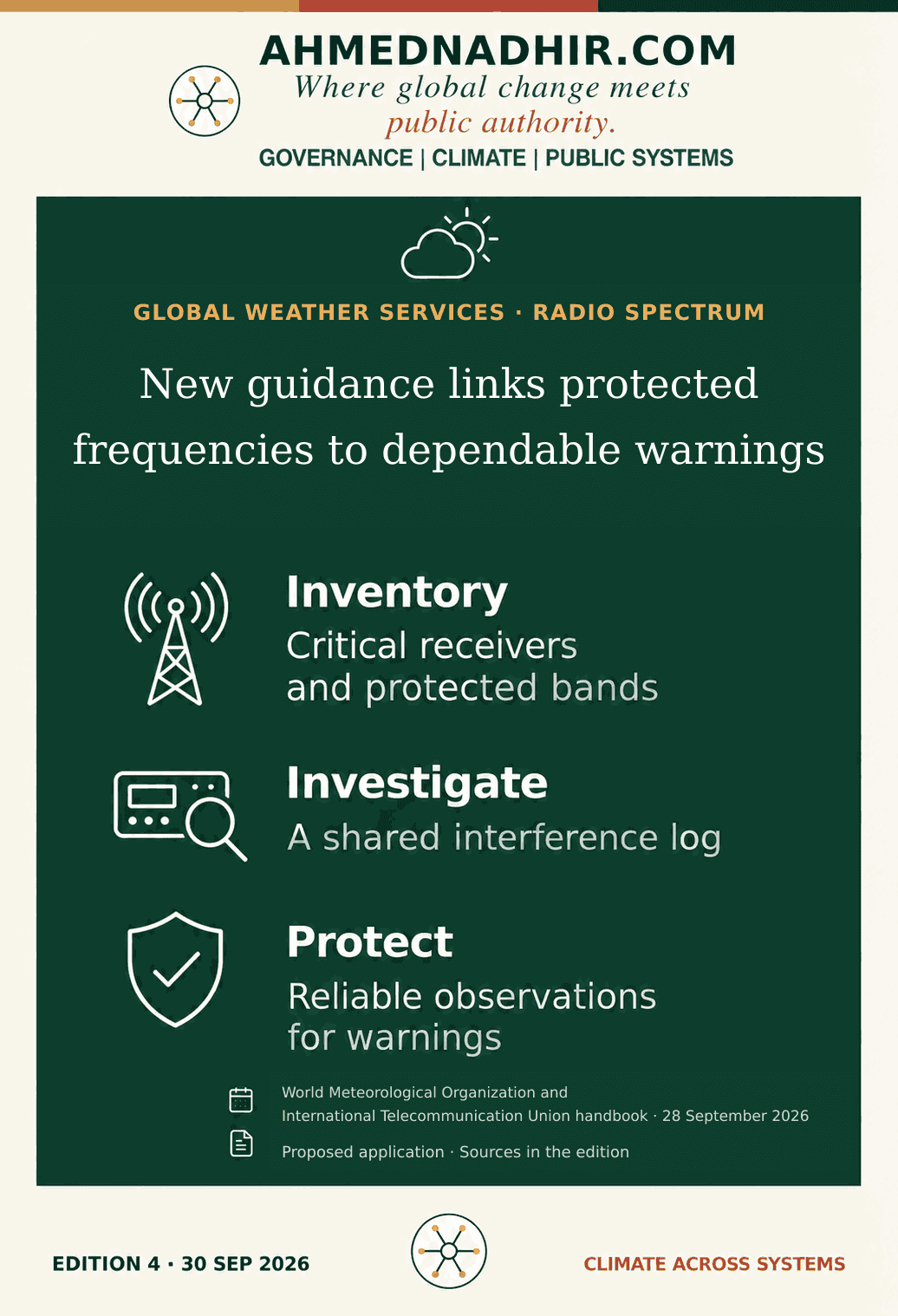
The World Meteorological Organization (WMO) and International Telecommunication Union (ITU) released an updated handbook on 28 September about the radio spectrum used for weather, climate and water services. Some satellite sensors read extremely faint natural signals in specific frequency bands. Radar, lightning networks, marine and aircraft observations, and data links also depend on radio systems. Harmful interference can make an observation less accurate or unavailable.
The issue reaches beyond a technical allocation table. A meteorological service needs dependable observations before it can issue a useful warning to a farmer, hospital or flood authority. Demand for wireless and satellite services is growing at the same time. The handbook calls for coordination between spectrum regulators and meteorologists so that new uses are assessed alongside the observation systems they may affect.
For Kenya, a sensible application would be a joint inventory by the Communications Authority and the Kenya Meteorological Department of protected bands, critical receivers and a contact route for reporting suspected interference. The regulator can test proposed assignments against those needs and document how a complaint is investigated; the meteorological service can record missing or degraded data. Regional services can share findings when a satellite or warning chain crosses borders.
The WMO–ITU release identifies a risk and offers guidance. It does not report a Kenyan interference event or quantify a forecast improvement from any proposed domestic measure.
Food, waste and methaneKenya · County markets and early-childhood centres
Recover edible surplus while it can still nourish
United Nations Environment Programme story published 28 September 2026
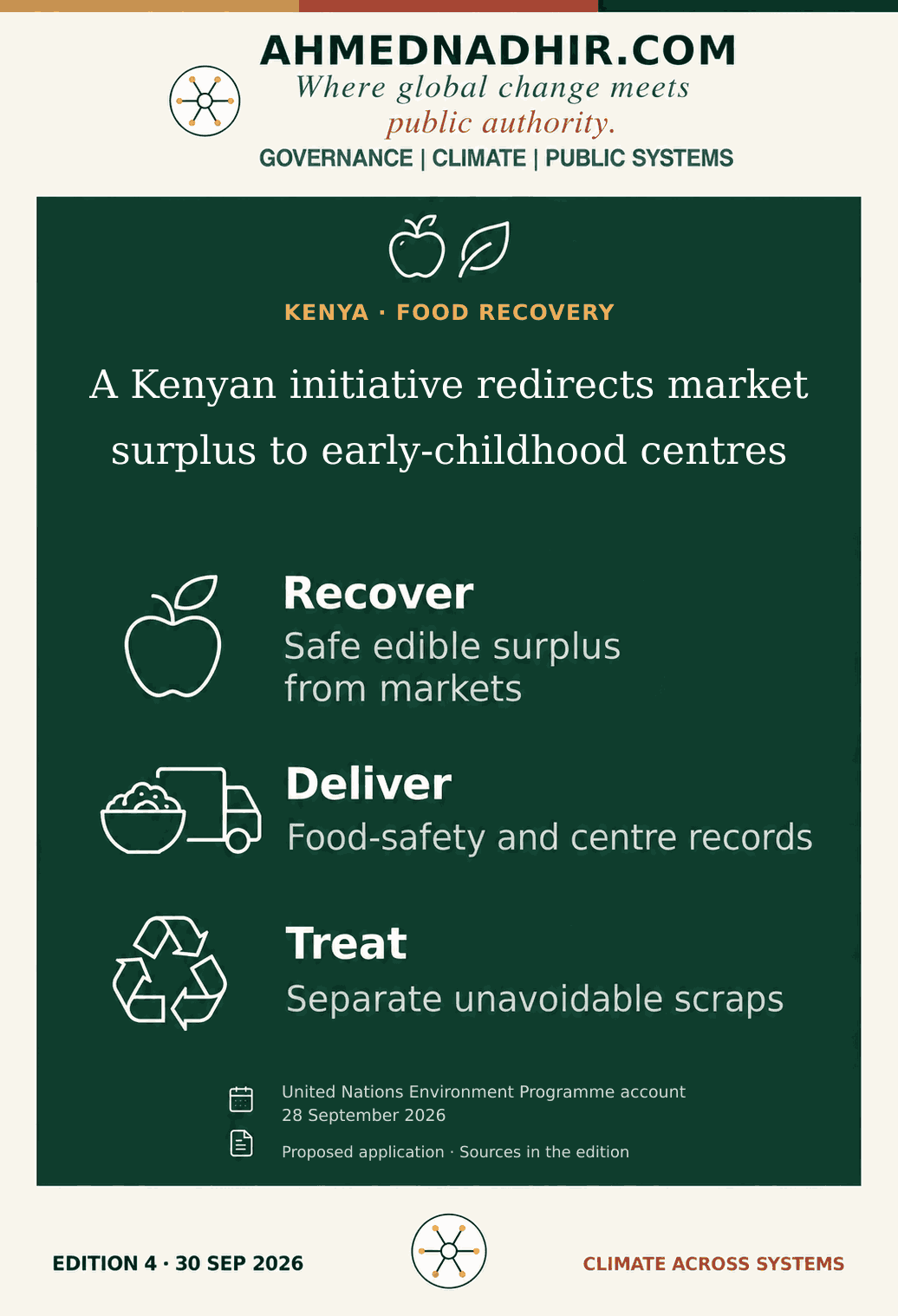
Ahead of the 29 September international day on food loss and waste, the United Nations Environment Programme (UNEP) described the climate cost of food left to rot in landfill. Organic waste produces methane when it breaks down without oxygen. Prevention and safe recovery therefore sit before disposal in the public decision: a market or supply chain should first identify edible surplus, then manage unavoidable scraps separately.
UNEP points to a Climate and Clean Air Coalition-backed initiative in Kenya that it says is redirecting surplus food to early childhood education centres in underserved communities. The Coalition’s project description sets out baseline assessments and a food-banking strategy. Neither public account provides a verified national total of food recovered, meals served or methane avoided. The project should be understood through those limits.
County market authorities, early-childhood services, food banks and public-health officers could agree which food may be redistributed, how temperature and transport are checked, who receives it, and how a centre records a delivery. The same route needs a plan for scraps that cannot safely be eaten: separate collection, suitable composting or another controlled treatment, with waste workers included. A few traceable sites would reveal the practical costs before anyone claims a citywide result.
A credible public account would report tonnes of edible food accepted and rejected, the reason for rejection, centres served and the disposal route for residual waste. Any methane estimate needs a stated baseline and method. Food safety and children’s nutrition are outcomes in their own right; a climate claim cannot stand in for them.
Construction and public procurementKenya · Ethiopia · Ghana · Tanzania · Uganda
Public tenders can open a market for lower-carbon cement
Global Alliance for Buildings and Construction announcement published 22 September 2026
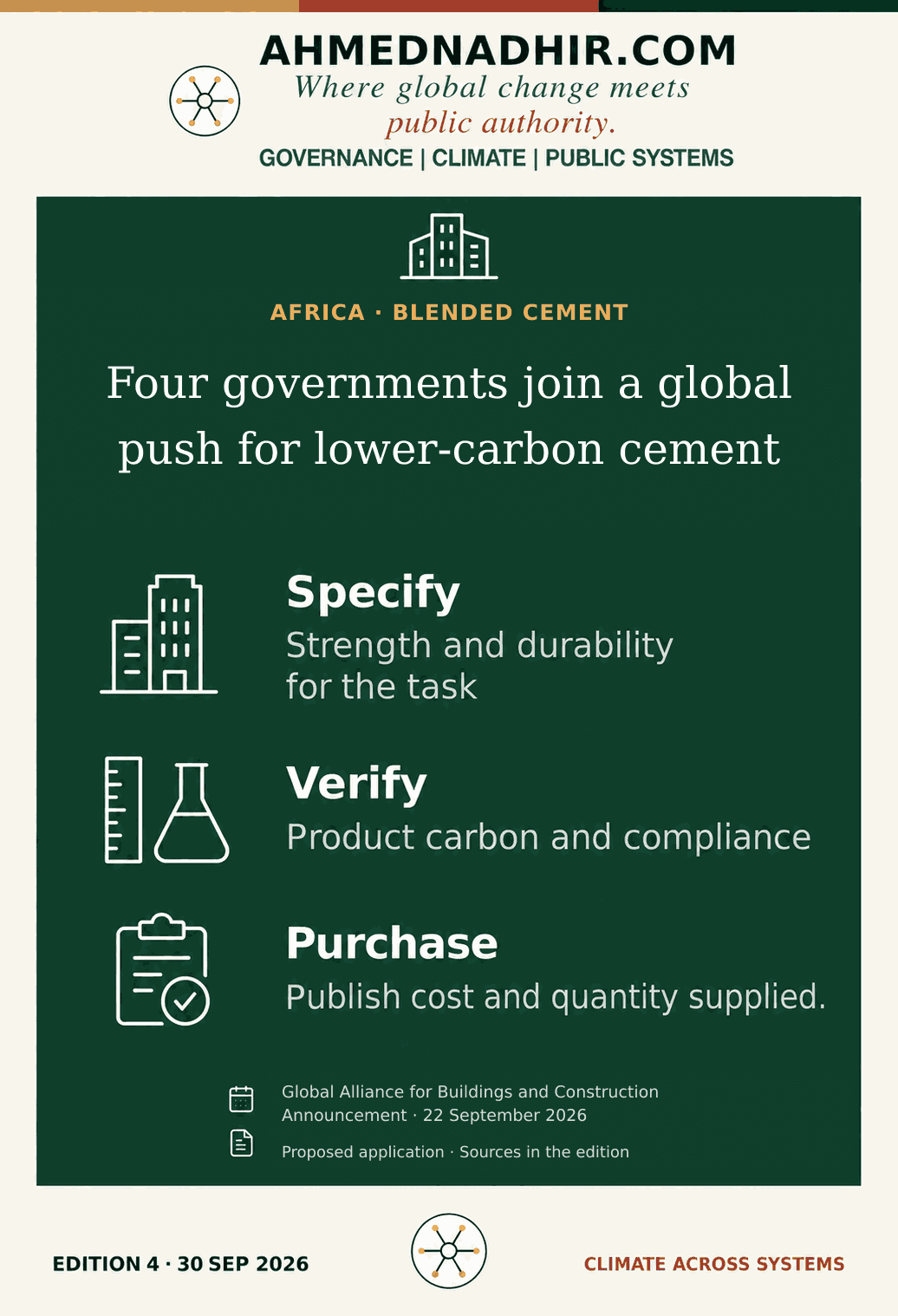
On 22 September, Ethiopia, Ghana, Tanzania and Uganda joined Cambodia as new supporters of an intergovernmental call to advance blended cement. Kenya was already among the supporters. The United Nations Environment Programme-hosted Global Alliance for Buildings and Construction (GlobalABC) says the twelve governments intend to use tools such as standards and public purchasing to encourage lower-clinker products.
Blended cement replaces some of the clinker used in ordinary Portland cement with suitable materials such as calcined clay, limestone or industrial by-products. The coalition says particular blends can cut emissions per tonne of cement by as much as half against that conventional benchmark. The upper figure is a product comparison, not a measured saving for every project or a promise of equivalent results across all uses.
A public works agency has considerable buying power, but its tender must describe the performance it needs. Standards bodies, engineers and procuring ministries in Kenya and the new member countries can agree acceptable strength and durability tests for local conditions, specify verified carbon declarations, and start with projects for which suitable blends are available. A bidder should be able to show both compliance and an independently checkable emissions calculation. The public should also see the price, maintenance implications and actual quantity purchased.
Support for the call does not establish that a national building code changed on 22 September. A published standard, procurement clause and compliant delivery record would show the next stage.
Shared water and livelihoodsTanzania · Eight Zambezi basin states
A shared river needs a shared account of resilience
Workshop held 9–11 September · African Development Bank release published 23 September 2026
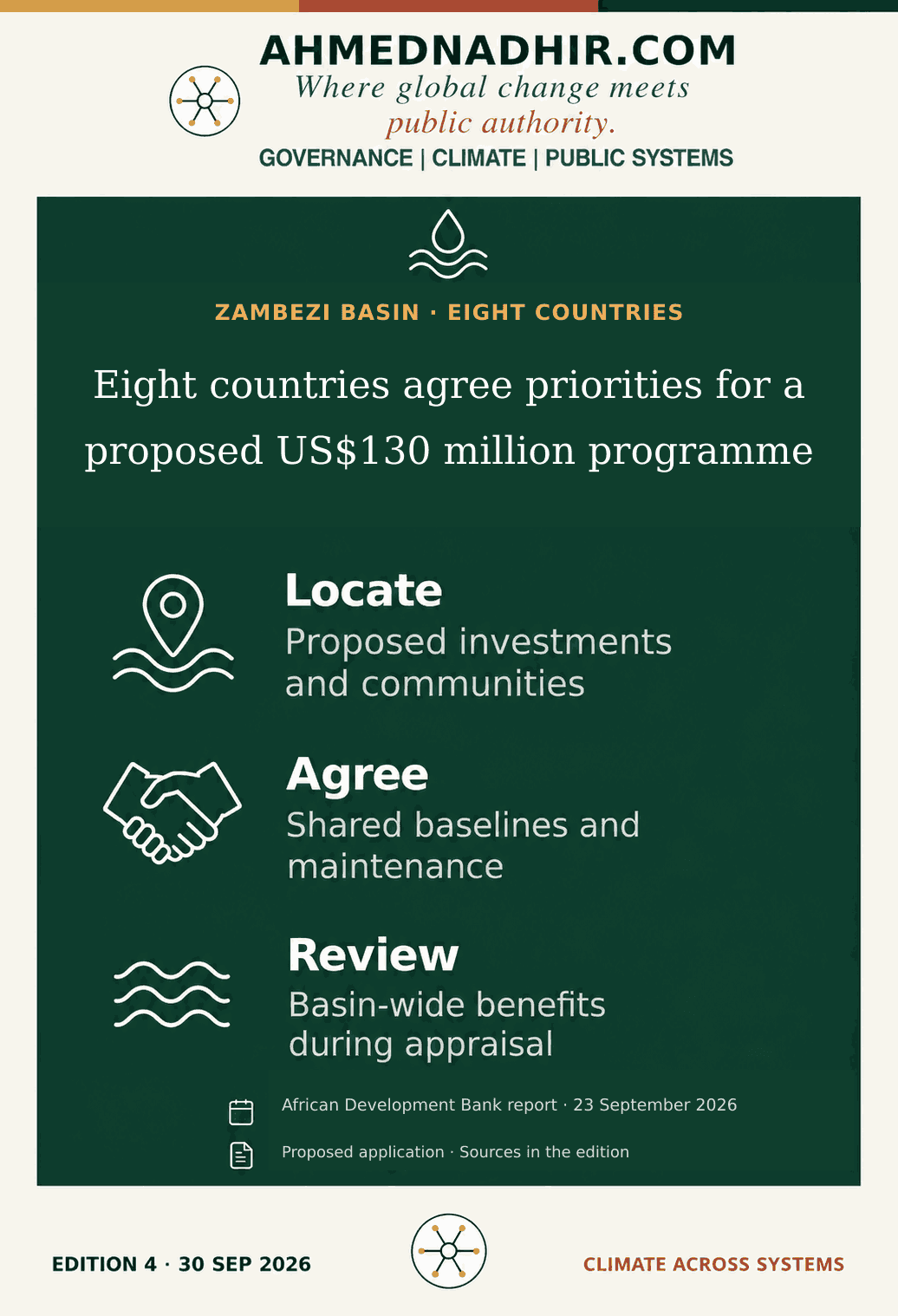
Representatives of the eight countries sharing the Zambezi basin agreed priority actions for a proposed US$130 million resilience programme at a Harare workshop on 9–11 September. The African Development Bank reported the agreement on 23 September and said an appraisal mission would review the design. Tanzania is among the basin states, alongside Angola, Botswana, Malawi, Mozambique, Namibia, Zambia and Zimbabwe.
The programme aims to improve food security, livelihoods and ecosystems. Those aims are connected across a river: land management upstream can affect water and sediment downstream, while drought, irrigation and flood choices can shift risk across borders. National projects will be easier to justify if their benefits and trade-offs can be seen within the same basin account.
The Zambezi Watercourse Commission (ZAMCOM) and each country’s water, land and agricultural agencies can identify the communities and ecosystems intended to benefit, publish shared baselines for water and land condition, and decide who maintains a restored site or monitoring station. Appraisal should make room for affected people to question the allocation of costs and benefits. A common annual results series would help distinguish works completed from resilience claimed.
Priority agreement and a proposed programme amount are early steps. The sources reviewed do not establish approved disbursements, completed interventions or measured gains from this programme. Its appraisal documents will be the next important public record.
Reflections
Who can turn the evidence into a decision?
- Forest authorities can recognise land use.
- Spectrum regulators can protect the observations behind warnings.
- Food and health authorities can make recovery safe and traceable.
- Engineers can verify a material’s performance and carbon claims.
- Basin agencies can account for effects across borders.
Each relevant institution should leave a practical public record as the commitment moves into practice: what it recognised, protected, delivered, verified or accounted for.
For Kenya
Connect land, county services, communications regulation and public procurement to a common question: who maintains the benefit after the initial investment?
For Africa and the Global South
Use shared standards and basin cooperation to reduce the cost of obtaining credible evidence, while retaining local rights, expertise and scrutiny.
For international partners
Fund maintenance, community participation and public data alongside assets. Appraisal can identify these duties before finance is committed.
References
The evidence behind the five readings
- Food and Agriculture Organization of the United Nations release, 28 September 2026
- The State of the World’s Forests 2026
- World Meteorological Organization and International Telecommunication Union, 28 September 2026
- International Telecommunication Union handbook, 2026
- United Nations Environment Programme, 28 September 2026
- Climate and Clean Air Coalition, Kenya project
- Global Alliance for Buildings and Construction, 22 September 2026
- African Development Bank, 23 September 2026
Official assessments, guidance and programme announcements establish different things. The analysis keeps global estimates separate from local results, product potential separate from procurement outcomes, and proposed finance separate from approved expenditure.