Public authority · Technology · Institutional capability
Government technology: oversight, computing and integrity
The Machinery of Public Control
Five recent publications examine how governments oversee artificial intelligence (AI), sustain computing services and enforce integrity, with lessons for Kenya, the Global South and the wider world.
In this week’s edition
The governance test
Can the institution see, challenge and change?
See the systemPublic records of uses, authority and consequences
Challenge its effectsEvidence, independent scrutiny and a route of appeal
Change its coursePeople, review powers and continuing resources
Governance interpretation drawing on the five publications. These relationships express administrative requirements, rather than measured causal effects.
Government AI
Working paper ·
Government AI is broad, shallow and uneven
Timothy Lundy, Manuel Ramos Maqueda, Shyam Jayanti Patel, Daniel Rogger, Flavia Sacco Capurro and Josefina Silva Fuentealba · World Bank
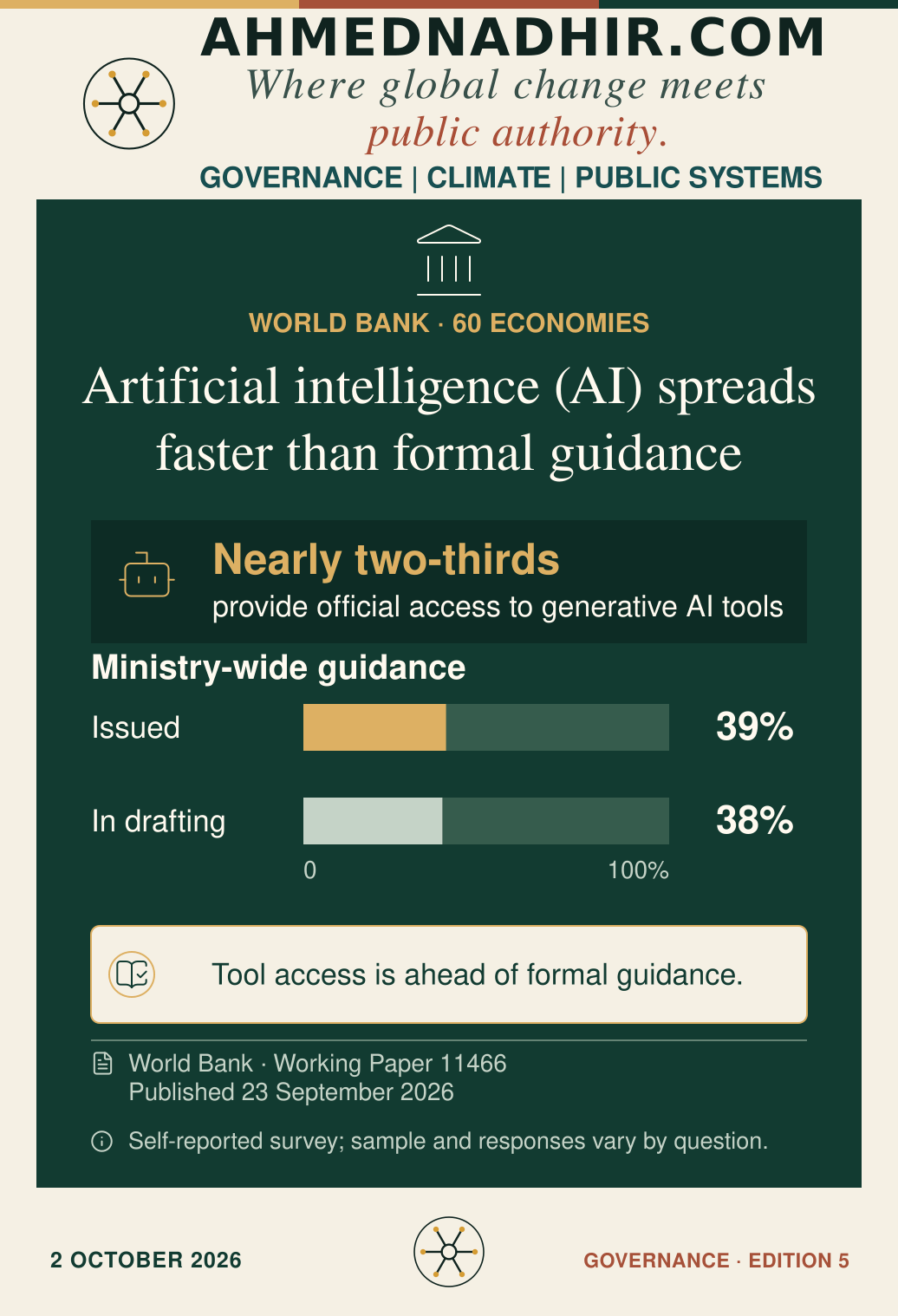
The World Bank working paper reports responses from central digital agencies, sector ministries and information-system leads in 60 economies. More than 60% of responding governments have adopted a national AI strategy, but only about half of those with a strategy report wide use across their organisations. Nearly two-thirds report official access or licences for generative tools, against 39% with formal ministry-wide guidance. The authors find adoption broad, shallow and uneven, with data and budget constraints across income groups. These are institutional self-reports, not independently measured service outcomes; 57 digital agencies answered the questionnaire behind the whole-of-government figures, and denominators vary by question.
Official tool access is more widespread than issued ministry-wide guidance. The survey measures reported arrangements, with responses varying by question.
Public responsibility across three settings
Kenya
The paper places Kenya among its 'integrators', above sample medians for adoption and readiness, on self-reported indices rather than audited outcomes. Ministries and counties still need inventories, named owners, data checks and measures of service performance, with usable escalation routes for devolved services.
Global South
The finding that income does not fully predict AI practice argues for capability assessments by institution and function. Sector experience, especially in tax administration, may offer more useful lessons than a single national maturity score.
World
The public question is moving from whether government uses AI to whether the organisation surrounding a system can test it, supervise it and learn from error. Adoption statistics alone cannot answer that question.
Public registers
Research preprint ·
An inventory can reveal a system while concealing its consequences
Dipto Das and Shion Guha
A Global Comparison of Schemas, Transparency, and Interoperability in Public-Sector AI Registers and Inventories
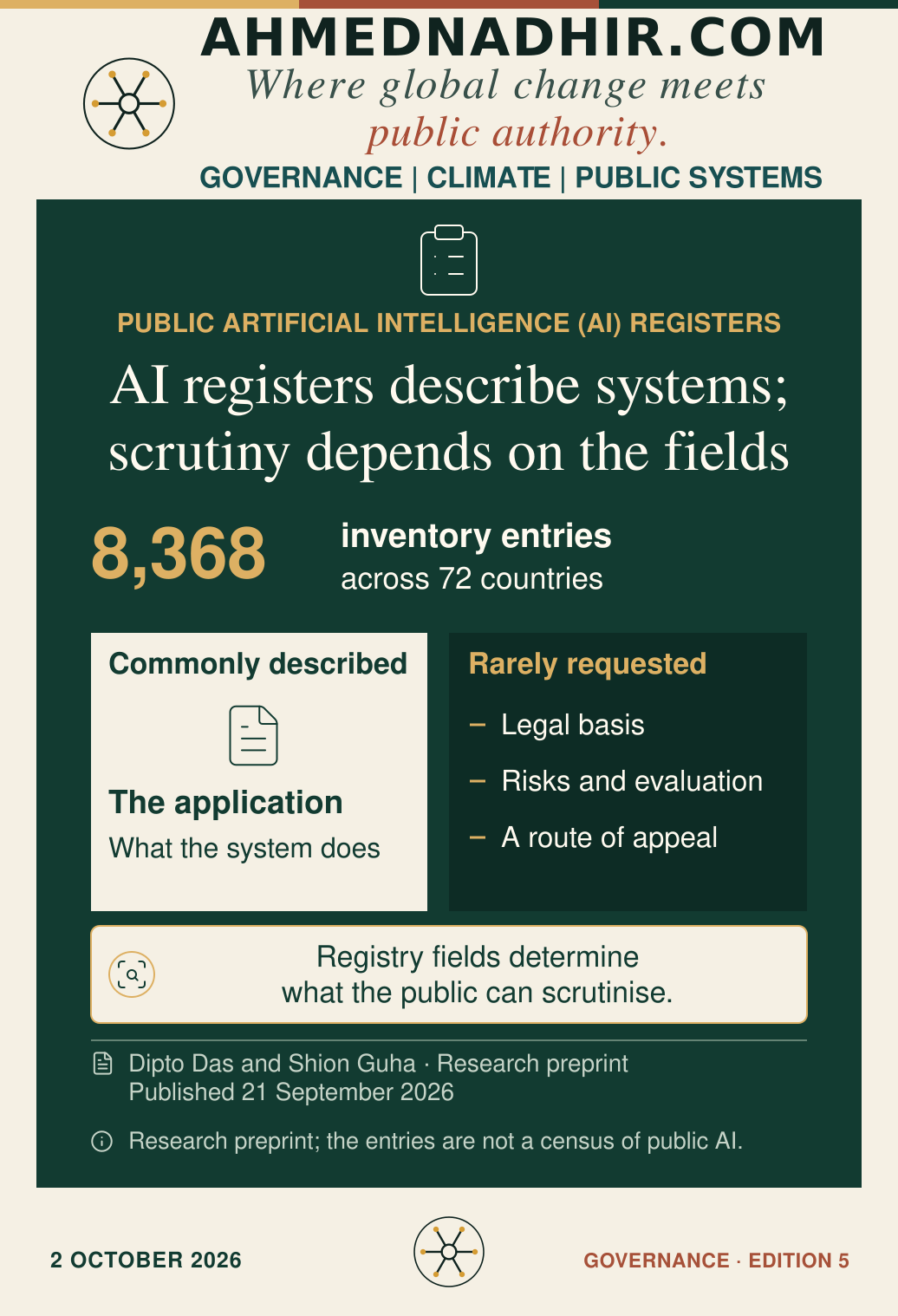
The study compares 8,368 entries in national and transnational inventories covering 72 countries. Across 23 harmonised fields, registers commonly describe an application but seldom request its legal basis, risks, external evaluation or route of appeal. Wider forms often contain many blank fields, and sources covering the same jurisdictions overlap only selectively. The 8,368 records are entries in the inventories studied, not an estimate of all public AI systems in those countries. This study is a research preprint.
An inventory entry can describe an application while offering little basis for scrutinising its use. The study distinguishes the fields commonly described from those rarely requested.
Public responsibility across three settings
Kenya
Any public AI register should connect each listed use to the procuring body, responsible official, vendor, legal authority, affected service, assessment and complaint route. National and county entries need compatible definitions, so a devolved service does not disappear between separate reporting systems.
Global South
A modest register with complete, consequential fields may serve oversight better than a large template that institutions lack the capacity to maintain. Shared standards should permit comparison while preserving the context of local law and service delivery.
World
A register is an accountability instrument only when its fields reveal who may act and how an affected person may challenge a decision. Counting entries is a weak substitute for testing completeness and usefulness.
Algorithmic safeguards
Peer-reviewed study ·
Safeguards shape what government learns to call a risk
Tynke Schepers, Floris Bex, Shirley Kempeneer and Albert Meijer · Data & Policy
More than a ritual: the recursive dynamic between governance instruments for algorithmization and algorithmic risk
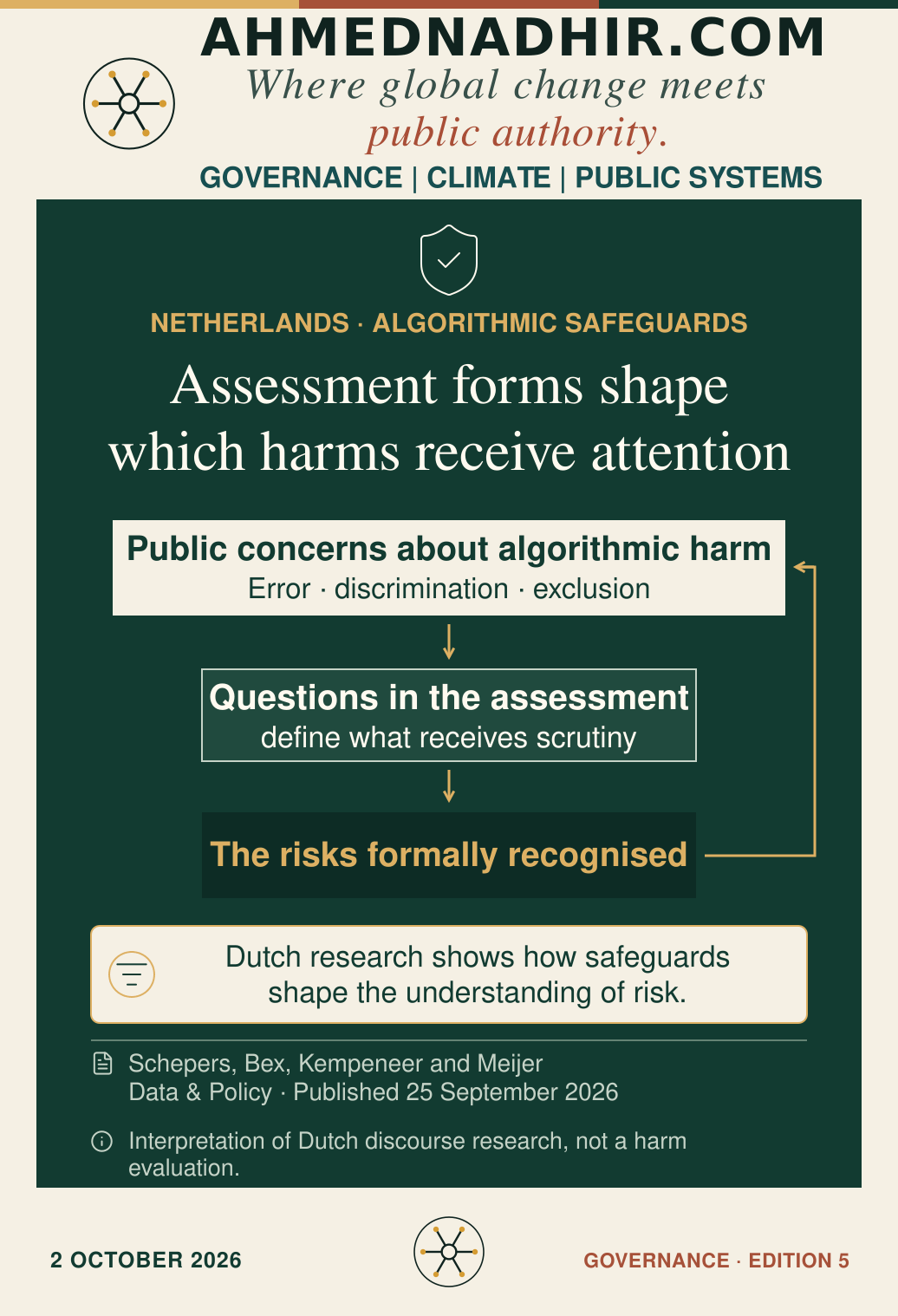
The article codes 135 newspaper articles, 12 advisory reports and 85 parliamentary documents from the Netherlands, dated 2018 to July 2024. The authors find that readily visible procedural safeguards can attract attention at the expense of more demanding institutional change. They also identify growing attention to fundamental rights and learning among public servants. This is a study of how risks and instruments were framed in one national debate; it does not establish that a particular safeguard reduced harm in practice.
The documentary basis of the Dutch study
Newspaper articles135
Parliamentary documents85
Advisory reports12
Source: Schepers and colleagues. Coded material, 1 January 2018–15 July 2024. Counts describe the dataset, rather than the effectiveness of safeguards.
Assessment instruments do more than record risk: the questions they ask help define which harms government recognises. The diagram interprets the study’s account of this feedback.
Public responsibility across three settings
Kenya
An impact assessment should ask how an algorithm changes discretion at the counter, in the county office or in an appeal. Training, records and review powers matter when an assessment identifies a problem. Publishing a form without assigning a remedial decision leaves the underlying practice untouched.
Global South
Frameworks imported from other jurisdictions may privilege risks that are easiest to document while missing language, access and administrative exclusion. Local civil servants and affected communities should help define what counts as harm.
World
Oversight bodies should periodically examine the safeguards themselves: which risks they make visible, which remain outside the form and whether officials can change a system after concerns emerge.
Sovereign infrastructure
Institutional report ·
Local computing requires an institution behind the equipment
United Nations Development Programme (UNDP)
Local AI compute infrastructure in Africa: Lessons from six country-hosted deployments on governance and effective use
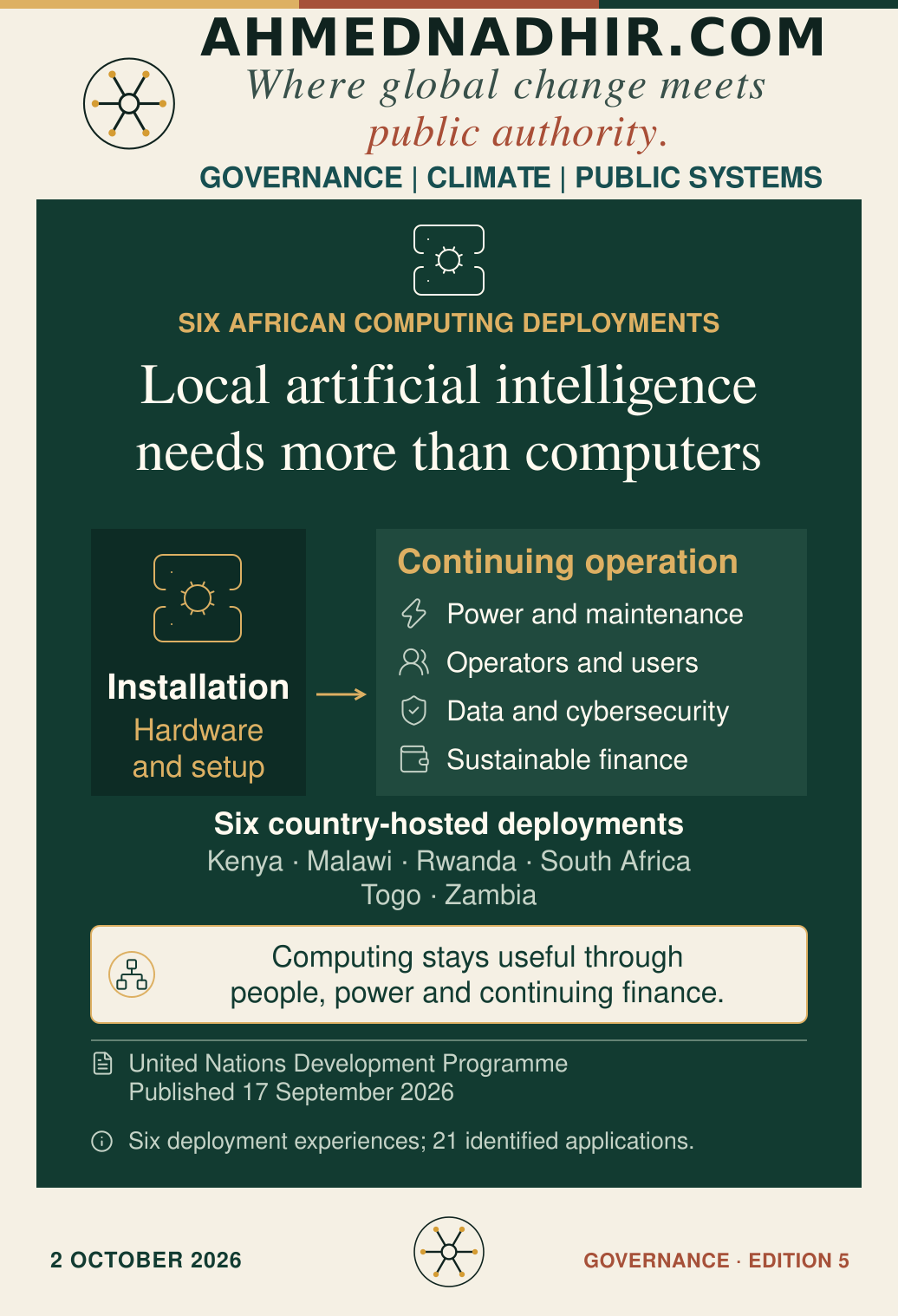
The report draws on deployments in Kenya, Malawi, Rwanda, South Africa, Togo and Zambia. The programme identified 21 AI applications across the six countries, a count of identified uses rather than completed services. The report follows capacity from design and procurement to installation, activation and operation, stressing data, skilled people, cyber security, governance and recurring finance. Six implementation experiences are neither a representative estimate of African computing needs nor proof that local hosting alone delivers sovereignty.
Installation and operation have different requirements. The six deployment experiences show why equipment needs users, data, technical staff and continuing finance.
Public responsibility across three settings
Kenya
Public investment in computing should specify who allocates access, pays recurring operating costs, protects data, maintains equipment and judges public value. National facilities need terms that make capacity usable by researchers and public institutions beyond the centre, including devolved services where appropriate.
Global South
Regional cooperation can widen access to scarce engineering capacity and specialist computing. The strongest sovereignty claim rests on durable control over use, maintenance and replacement, not only on the physical location of hardware.
World
Infrastructure policy has become part of administrative design. A server can be purchased once; the authority and competence to operate it must be sustained.
Public integrity
Country review ·
Integrity rules need authority that survives the announcement
Organisation for Economic Co-operation and Development (OECD)
OECD Integrity Review of the Dominican Republic: Implementing a Strategic Vision for Public Integrity and Anti-Corruption
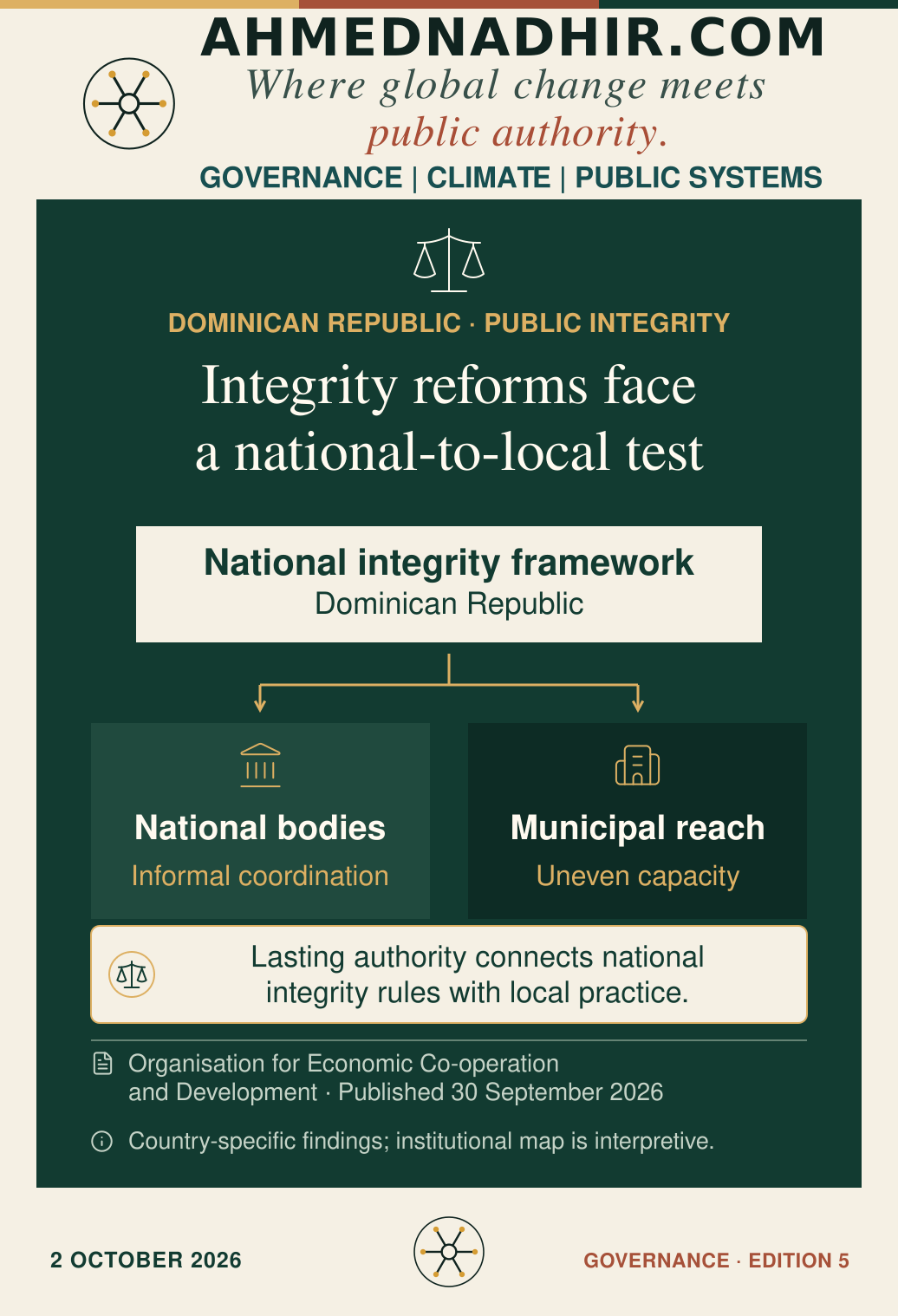
The review finds progress in creating integrity bodies and a national strategy, alongside gaps in implementation. Coordination remains largely informal; the central integrity directorate was established by decree and lacks statutory guarantees for independence. The review calls for integrity arrangements to reach municipalities and addresses conflicts of interest, audit, whistleblowing, lobbying and political finance. This is a country review, so its institutional prescriptions require judgement before use elsewhere.
National reforms reach citizens through the bodies implementing them. The country review identifies informal coordination and the need for stronger local capacity.
Public responsibility across three settings
Kenya
The practical parallel is the distance between national integrity standards and routine decisions made in ministries, agencies and counties. Clear mandates, credible internal audit, protected reporting and county-level capacity must support the rules already in force.
Global South
A new commission or strategy can establish direction, but its authority depends on legal durability, coordination and resources outside the capital. The Dominican case invites comparison, not imitation.
World
Integrity is a continuing administrative system. Public trust depends on whether institutions can detect a conflict, act on it and show the result.
The governing question
What makes control real?
Across the five readings, control has several layers. Government must know what it has deployed; record the authority and consequences of each use; possess the staff and infrastructure to intervene; and maintain integrity arrangements capable of reaching the place where decisions are made. Each layer is necessary, and none is established by a strategy document alone.
Reflections for policy work
Three questions to carry into the institution
Where is the public inventory?
Can a responsible public body identify each consequential AI use, its legal authority, supplier, data, risk assessment and route of appeal across national and devolved services?
Who can change the system?
When evidence of error or exclusion emerges, which official has the technical access, contractual power and administrative authority to pause, repair or withdraw it?
What survives the launch?
Are the people, budgets and institutional mandates in place to operate infrastructure, refresh safeguards and enforce integrity rules after initial attention has moved elsewhere?
Public control is demonstrated in the ordinary ability to see a system, interrogate its effects and alter its course. The week’s research makes that capacity a more demanding measure of governance than adoption, disclosure or ownership taken separately.
Original publications
Sources and publication dates
The research accounts above report each publication’s claims. The governance readings and synthesis are independent analysis.