
Where is the public inventory?
Can a responsible public body identify each consequential AI use, its legal authority, supplier, data, risk assessment and route of appeal across national and devolved services?
Edition in Brief
The Machinery of Public Control
Five recent publications examine how governments oversee artificial intelligence (AI), sustain computing services and enforce integrity, with lessons for Kenya, the Global South and the wider world.
The publications in focus were published between 17 September and 1 October 2026. None featured in an earlier edition.
Across 60 economies, adoption is advancing faster than the institutions around it.
Read the finding and its implications →8,368 inventory records reveal the difference between disclosure and useful scrutiny.
Read the finding and its implications →Dutch research asks which risks an official safeguard makes visible, and which it misses.
Read the finding and its implications →Six African deployments connect local computing with skills, data and recurring finance.
Read the finding and its implications →A Dominican Republic review tests the durability and local reach of integrity arrangements.
Read the finding and its implications →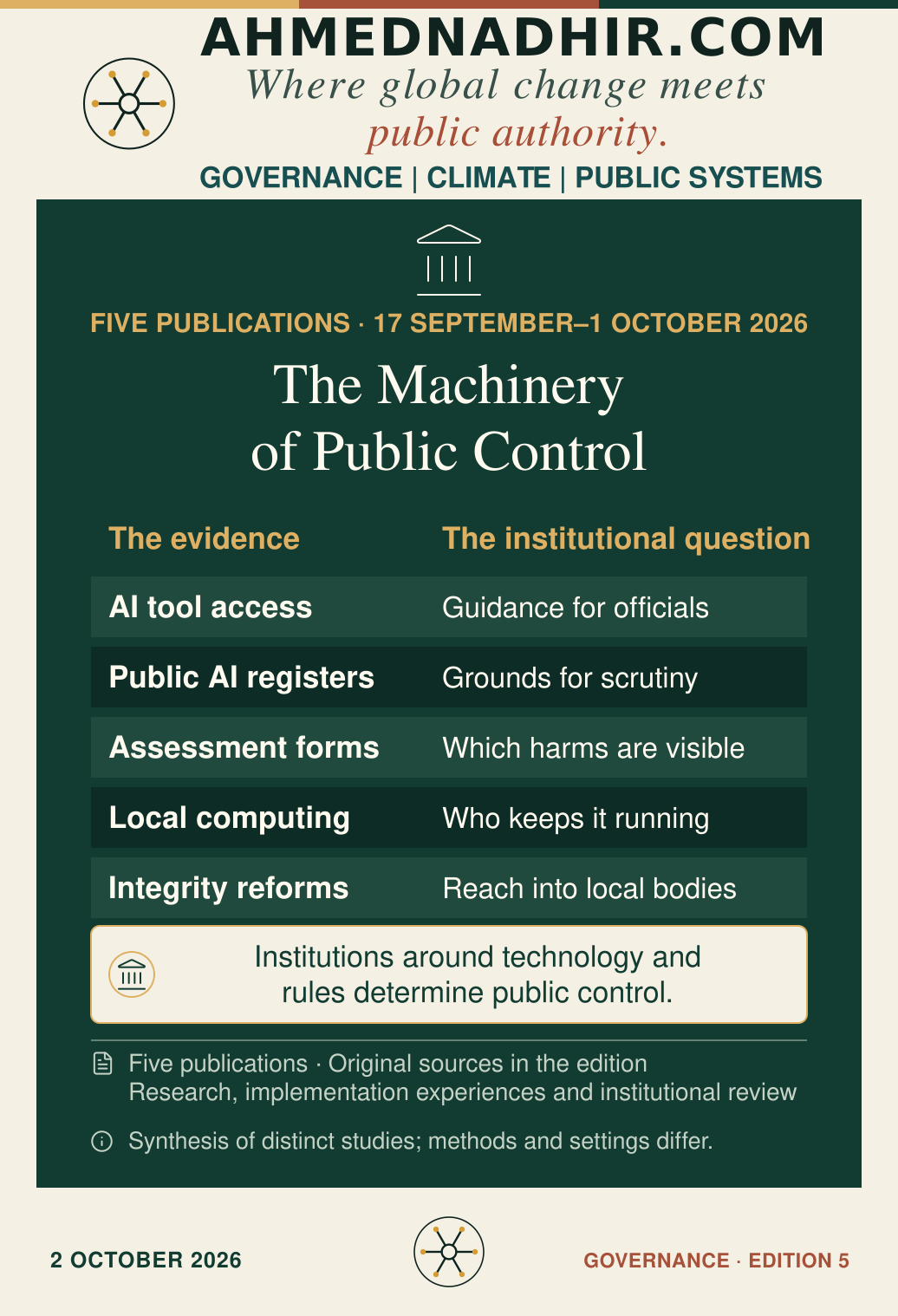
The central finding
Across the five readings, control has several layers. Government must know what it has deployed; record the authority and consequences of each use; possess the staff and infrastructure to intervene; and maintain integrity arrangements capable of reaching the place where decisions are made. Each layer is necessary, and none is established by a strategy document alone.
The sources differ in method and reach. A self-reported survey, a research preprint, Dutch discourse analysis, six African implementation experiences and a country integrity review illuminate related questions without establishing a single universal model.
For policy work
Can a responsible public body identify each consequential AI use, its legal authority, supplier, data, risk assessment and route of appeal across national and devolved services?
When evidence of error or exclusion emerges, which official has the technical access, contractual power and administrative authority to pause, repair or withdraw it?
Are the people, budgets and institutional mandates in place to operate infrastructure, refresh safeguards and enforce integrity rules after initial attention has moved elsewhere?
Public control is demonstrated in the ordinary ability to see a system, interrogate its effects and alter its course. The week’s research makes that capacity a more demanding measure of governance than adoption, disclosure or ownership taken separately.
Read the latest edition and its sources →Download the full-edition PDF ↓