Public services · Spending · Information · Participation
Public spending, personal data and the citizen’s voice
What Government Counts, and Whom It Hears
Five recent publications examine how public institutions count prevention spending, decide who may use personal data and respond to citizens, and what government reform needs to make those decisions accountable.
In this week’s edition
The five publications examined in this edition were issued from 12 to 15 October 2026 by the Organisation for Economic Co-operation and Development (OECD). None was the focus of an earlier edition.
The information behind a public decision
What enters the account changes the choice
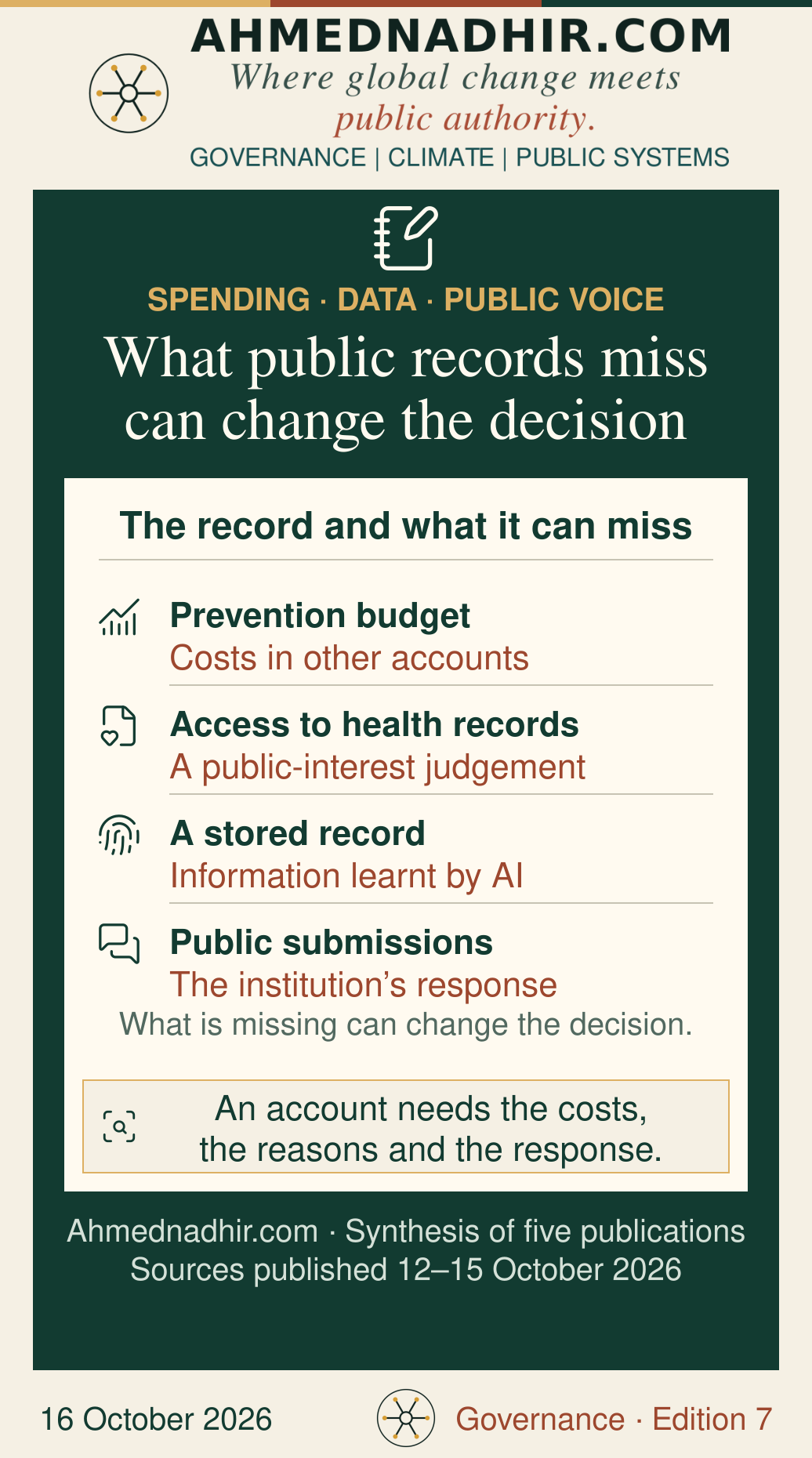
A prevention budget can look small because spending sits in other accounts. A proposal to reuse health records can promise a benefit without explaining who gains or who decides. A consultation can collect views without showing how they affected the decision.
This edition follows those gaps into the institution. Its readings ask how officials record expenditure, authorise another use of information and explain what happened to a citizen’s contribution, and what the institution needs to do that work.
What enters a public decision, and what can be left outside it. Ahmednadhir.com’s synthesis of this edition’s five publications.
Government reform
Comparative government reform report
A digital service still depends on the institution behind it
Published by Organisation for Economic Co-operation and Development (OECD) ·
Government Unstuck: The Next Frontier of Government Transformation
The OECD brings evidence on public participation, administrative complexity, fiscal flexibility and digital capability into a programme of government reform. Its account of 2025 survey findings shows a revealing difference: 68% of respondents across OECD member countries believed voting influenced government, while 31% felt people like them had a say in decisions. The report argues for changes to public-service skills, internal procedures, budgeting and citizen engagement, alongside better connected data and responsible use of artificial intelligence (AI).
Why it matters for governance
Kenya
For Kenyan ministries and counties, a useful starting point is a recurring service problem whose records cross departmental boundaries. A digital referral or licensing system will expose unresolved handovers if staff cannot change the process behind the screen. Reform needs a named service responsibility, budget support and evidence from the people using it.
Global South
Where fiscal space and specialist staff are scarce, importing a comprehensive reform model can overload the same officials expected to deliver services. Sequencing around a few high-volume services offers a more credible route, provided simplification preserves safeguards against exclusion, arbitrary discretion and misuse of public money.
Wider world
Digital sovereignty includes the ability to determine how information changes an administrative decision. National control of infrastructure is incomplete if public bodies cannot connect relevant records, explain the resulting action or hear a challenge from the person affected.
OECD report, 12 October 2026, citing 2025 survey findings. The questions are distinct; the figures describe perceptions.
A digital service inherits the decisions, handovers and constraints of the institution running it.
Prevention spending
Health working paper · initial estimates
Prevention spending can disappear inside a larger budget
Published by Organisation for Economic Co-operation and Development (OECD) ·
Improving estimates of spending on prevention and public health in the European Union
Authors: David Morgan, Michael Mueller and Nikita Ramachandran, OECD
Reported prevention spending accounts for around 3% of total health expenditure across the European Union. This working paper examines reporting gaps and develops methods to estimate missing activity. Initial results suggest preventive spending may be underestimated by around one-quarter, particularly in health-condition monitoring and epidemiological surveillance. Activities embedded within larger programmes or spread across institutions are difficult to classify consistently.
Why it matters for governance
Kenya
For national and county health teams, the immediate lesson concerns the quality of the expenditure record. Surveillance staff, outreach transport and prevention activities may sit within broader cost centres. Reconciling programme activity with actual expenditure can improve a budget discussion before any claim is made about whether prevention is adequately funded.
Global South
Fragmented donor and domestic accounts can obscure the resources sustaining a preventive service. A consolidated view needs a defensible way to allocate shared costs and avoid counting the same activity twice. Greater detail is valuable only when reporting effort remains proportionate to its use.
Wider world
Comparisons between countries depend on what each reporting system includes. A low recorded share can reflect limited expenditure, incomplete classification or both. Correcting the account can improve policy judgement, but cannot by itself establish whether the resulting level of prevention spending is sufficient.
OECD working paper, 15 October 2026. European Union estimates. The illustration of dispersed accounts is Ahmednadhir.com’s analysis.
A budget category can understate an activity when its costs are recorded elsewhere.
Health records and public benefit
Policy guidance
A second use of health records needs its own public purpose
Published by Organisation for Economic Co-operation and Development (OECD) ·
Determining public interest in the secondary use of health data
This policy brief examines how authorised bodies judge access to health information for purposes beyond the care for which it was collected. It identifies five areas for assessing public interest: population health and planning; research and innovation; ethical and risk considerations; health equity; and public communication and transparency. Unclear definitions and different review practices can obstruct useful collaboration as well as weaken confidence in decisions.
Why it matters for governance
Kenya
Where hospital or county records are requested for a separate research or AI project, the proposal needs a defined public purpose, an appropriate decision-maker and a record of the conditions attached to access. Those considerations do not establish a legal basis by themselves; applicable authorisation and data-protection requirements still govern the decision.
Global South
Research partnerships can bring analytical capability while concentrating control over datasets and resulting knowledge elsewhere. A public-benefit assessment can examine who receives usable findings, whether local institutions gain capability and how the people supplying the information are protected.
Wider world
An important distinction emerges between a technically feasible use and a justified use. A consistent review process can make decisions more intelligible across organisations without assuming that all health-data projects present the same benefits, risks or distributional consequences.
Five areas for public-interest assessment in the OECD policy brief of 15 October 2026. Criteria guide judgement; they do not supply legal permission.
A claim of public benefit needs an accountable decision about purpose, risk and who gains.
Personal information and AI
Policy brief · emerging practices
Deleting a record and changing a trained model are different tasks
Published by Organisation for Economic Co-operation and Development (OECD) ·
Enhancing user control and privacy protections in the context of AI
The brief examines personal information collected through interactions with AI systems and through automated collection from public web pages. It reviews notices, opt-out tools, filtering, privacy-preserving methods and routes for redress. It also examines the difficulty created when a model retains information from its training data, including the developing possibilities of removing learned information from a model.
Why it matters for governance
Kenya
A public institution considering a chatbot needs to understand whether the service stores citizens' submissions, permits further training uses and offers a workable route for correction or complaint. Procurement terms and actual settings both matter. Restricting what users submit can reduce exposure, but cannot replace the institution's responsibility to govern its chosen service.
Global South
Publicly available material in local languages can enter systems developed elsewhere, sometimes with limited practical means for contributors to understand or contest the use. Bargaining over access, training permissions and redress is therefore part of digital sovereignty, alongside computing infrastructure and domestic technical skills.
Wider world
Control has to remain meaningful as information moves through collection, training and deployment. Removing a source record does not necessarily demonstrate that its information has been removed from a trained model. Public assurance needs evidence about the stage to which a promised control actually applies.
Ahmednadhir.com’s explanation of record deletion and information retained during training. OECD, 15 October 2026. Retention and available controls differ between models.
Control over a stored record and control over a model's learned information are different tasks.
Citizens and the public response
Country review and recommendations
Consultation needs a public account of the response
Published by Organisation for Economic Co-operation and Development (OECD) ·
Open Government Review of Australia: Strengthening Civic Space and Participation
The review finds a strong Australian participation landscape but uneven application, resources and co-ordination across the public sector. Its recommendations address participation skills, shared quality measures, more coherent digital arrangements and a common approach to explaining how public input was handled. The emphasis is on making engagement a regular part of governing rather than adding more disconnected consultation exercises.
Why it matters for governance
Kenya
For county planning and budgeting, the useful question is what happens to a submission after it is received. A clear account can connect an issue raised by residents to the body's response, the decision reached and any resulting change. Australian institutional arrangements are not a substitute for Kenya's own participation duties or local needs.
Global South
Digital platforms can widen access while excluding people facing language, disability, connectivity or time barriers. Participation design needs supported offline routes as well as a public record of how competing views were weighed. The capacity to respond deserves a place in the engagement budget.
Wider world
A consultation count measures an activity. Democratic accountability also requires an explanation of how decisions were reached, including why a well-supported proposal was declined. Shared standards can improve that explanation without promising that every contribution will be adopted.
Ahmednadhir.com’s explanation of the response recommended in the OECD’s Australia review, 12 October 2026. This is an institutional responsibility, rather than a measured policy effect.
A public response connects a person's contribution to the decision the institution made.
The governing question
Public decisions need the evidence, the reasons and the response
The publications expose several ways that a public decision can lose contact with the people it concerns. Prevention activity is dispersed across accounts. Personal information moves into new uses whose benefits and risks require fresh judgement. Public consultation generates submissions, but its value becomes difficult to assess when the response is missing. Government reform needs the staff, procedures and budget arrangements to address these gaps.
These are different problems, with different remedies. More spending does not repair an unclear account; better classification does not settle whether funding is enough. A technically secure data transfer does not establish a public purpose. A participation platform cannot supply the institutional willingness to explain a decision.
The common practical demand is a record that carries the relevant evidence, costs and disagreement into the decision, followed by an explanation people can examine. Public institutions need the skills and discretion to make that judgement, together with safeguards that make the use of discretion answerable.
Reflections for policy work
Three questions to carry into the institution
What is absent from the account?
Which shared costs, unrecorded activities or excluded experiences could change the apparent case for a service or budget choice?
Who authorises the next use?
When information is reused, who judges the purpose, risks and distribution of benefits, and what conditions follow the data?
Where can people see the response?
Can residents trace an issue they raised into the institution's reasons, decision and any subsequent change?
Original publications
Sources and publication dates
The research accounts report the publications’ claims. The governance readings, interpretive diagrams and synthesis are Ahmednadhir.com’s analysis. The sources differ in method and reach; their findings do not establish a common measured effect on public services.