
What is absent from the account?
Which shared costs, unrecorded activities or excluded experiences could change the apparent case for a service or budget choice?
What Government Counts, and Whom It Hears
Five recent publications examine how public institutions count prevention spending, decide who may use personal data and respond to citizens, and what government reform needs to make those decisions accountable.
The five publications examined in this edition were issued from 12 to 15 October 2026 by the Organisation for Economic Co-operation and Development (OECD). None was the focus of an earlier edition.
The OECD connects government reform with public-service skills, simpler procedures and a stronger voice in decisions.
Read the finding and its implications →An OECD working paper finds that European accounts may omit preventive work recorded within larger programmes.
Read the finding and its implications →OECD guidance sets out criteria for judging the public interest when health information is used for another purpose.
Read the finding and its implications →The OECD follows personal information from collection into training, and examines where user controls become difficult.
Read the finding and its implications →The OECD’s Australia review examines how public bodies handle participation and explain their response to citizens.
Read the finding and its implications →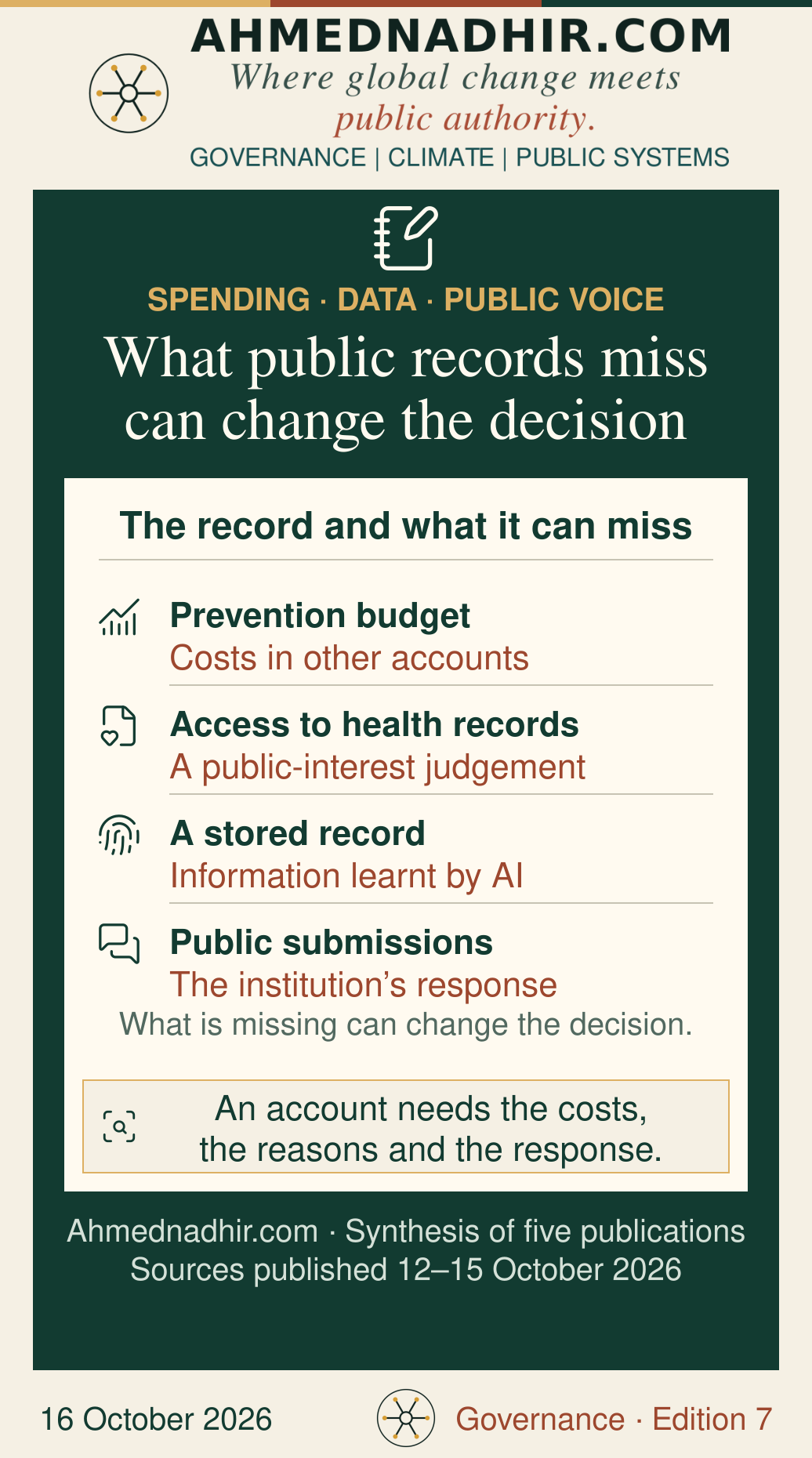
The governing question
The publications expose several ways that a public decision can lose contact with the people it concerns. Prevention activity is dispersed across accounts. Personal information moves into new uses whose benefits and risks require fresh judgement. Public consultation generates submissions, but its value becomes difficult to assess when the response is missing. Government reform needs the staff, procedures and budget arrangements to address these gaps.
The sources combine comparative and country reviews, initial expenditure estimates and policy guidance. The prevention estimates concern Europe; survey figures describe different perceptions. They do not measure a common effect or provide universal estimates.
For policy work
Which shared costs, unrecorded activities or excluded experiences could change the apparent case for a service or budget choice?
When information is reused, who judges the purpose, risks and distribution of benefits, and what conditions follow the data?
Can residents trace an issue they raised into the institution's reasons, decision and any subsequent change?
The common practical demand is a record that carries the relevant evidence, costs and disagreement into the decision, followed by an explanation people can examine. Public institutions need the skills and discretion to make that judgement, together with safeguards that make the use of discretion answerable.