
Who can change the arrangement?
When the public objective is not being met, which institution has the information and authority to alter the mandate, contract, rules or service pathway?
When Government Works Through Others
Five studies connect the costs of tax reliefs and public companies with funding for shared data, expertise in election technology and access to legal advice.
The five publications were issued from 16 to 22 October 2026. Four come from the Organisation for Economic Co-operation and Development (OECD), and one from the United Nations Development Programme (UNDP). Their evidence ranges from company records and comparative policy analysis to case studies and institutional surveys.
Only 48% of countries in the OECD comparison link public-service compensation to costs and require separate accounts.
Read the finding and its implications →Four country studies examine how tax reliefs enter the budget, making forgone revenue part of the choice about public support.
Read the finding and its implications →A review of more than 200 initiatives connects durable data sharing with member benefits, agreed rules and continuing finance.
Read the finding and its implications →A UNDP survey of 53 electoral management bodies examines institutional readiness, procurement and the governance of artificial intelligence.
Read the finding and its implications →Among people needing personalised advice, the median country-level rate of obtaining it is 38%. A referral alone does not show that help was received.
Read the finding and its implications →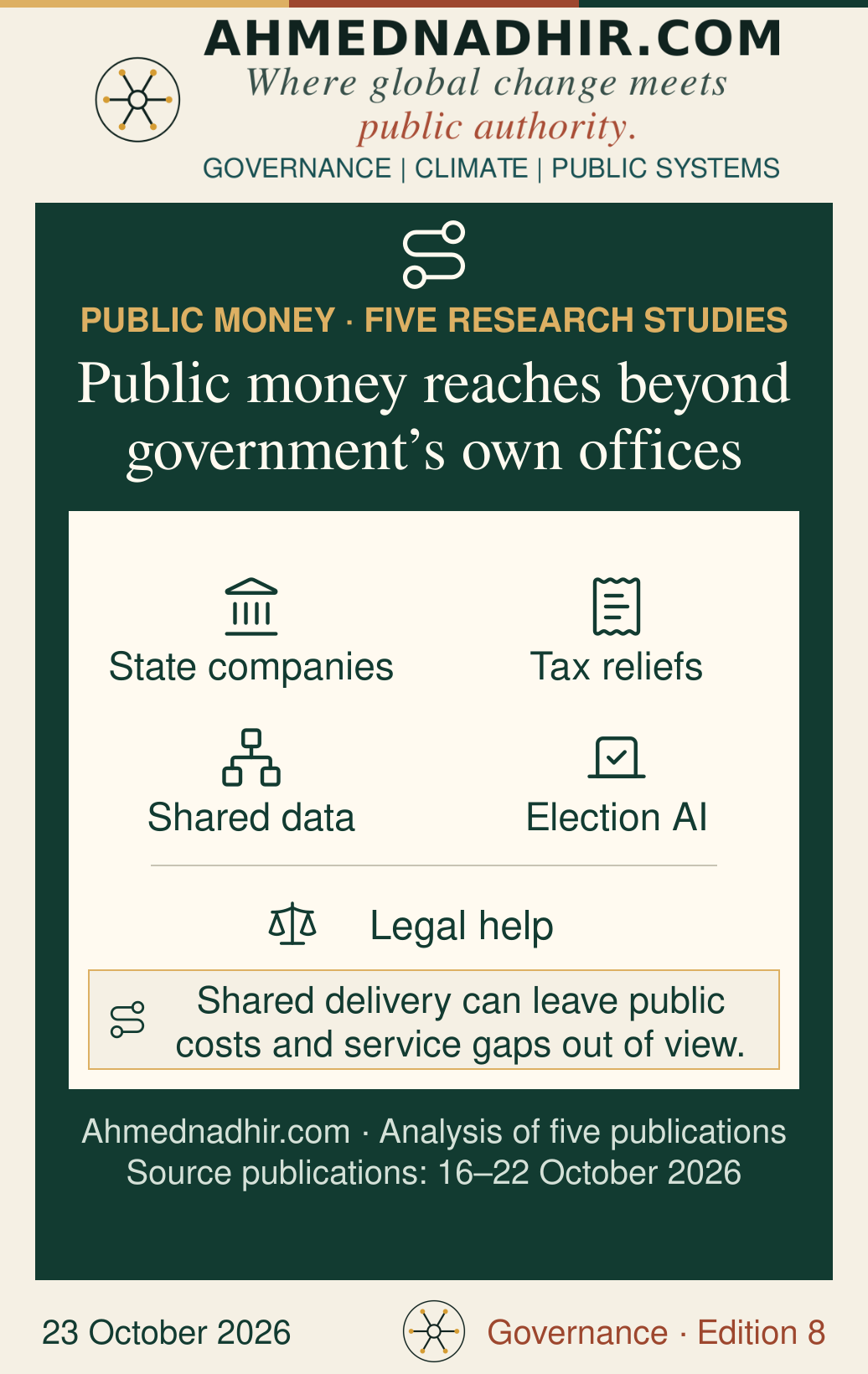
The governing question
The public cost can sit outside the line most people inspect. A company may carry the expense of a service obligation; a tax concession reduces revenue instead of recording a grant; a data partnership keeps generating bills after its start-up support ends.
Company assets are a stock, not a public spending total. The electoral survey covers institutions, while the justice figure is a median across country estimates for people needing advice. The data-space cases do not establish a representative failure rate.
For policy work
When the public objective is not being met, which institution has the information and authority to alter the mandate, contract, rules or service pathway?
Are forgone revenue, service subsidies, data preparation, continuing support and referral capacity visible in the decision about how the work will be financed?
Can someone affected identify a body that will examine the concern and explain its response, rather than pass responsibility between organisations?
The practical value of the research is to connect financial and institutional records with the service being delivered. Clear accounts, capable staff and follow-up help explain a subsidy’s purpose, a platform’s continuing value and whether a person referred for advice actually received it.