International research on public money and services
The public costs behind tax reliefs and shared services
When Government Works Through Others
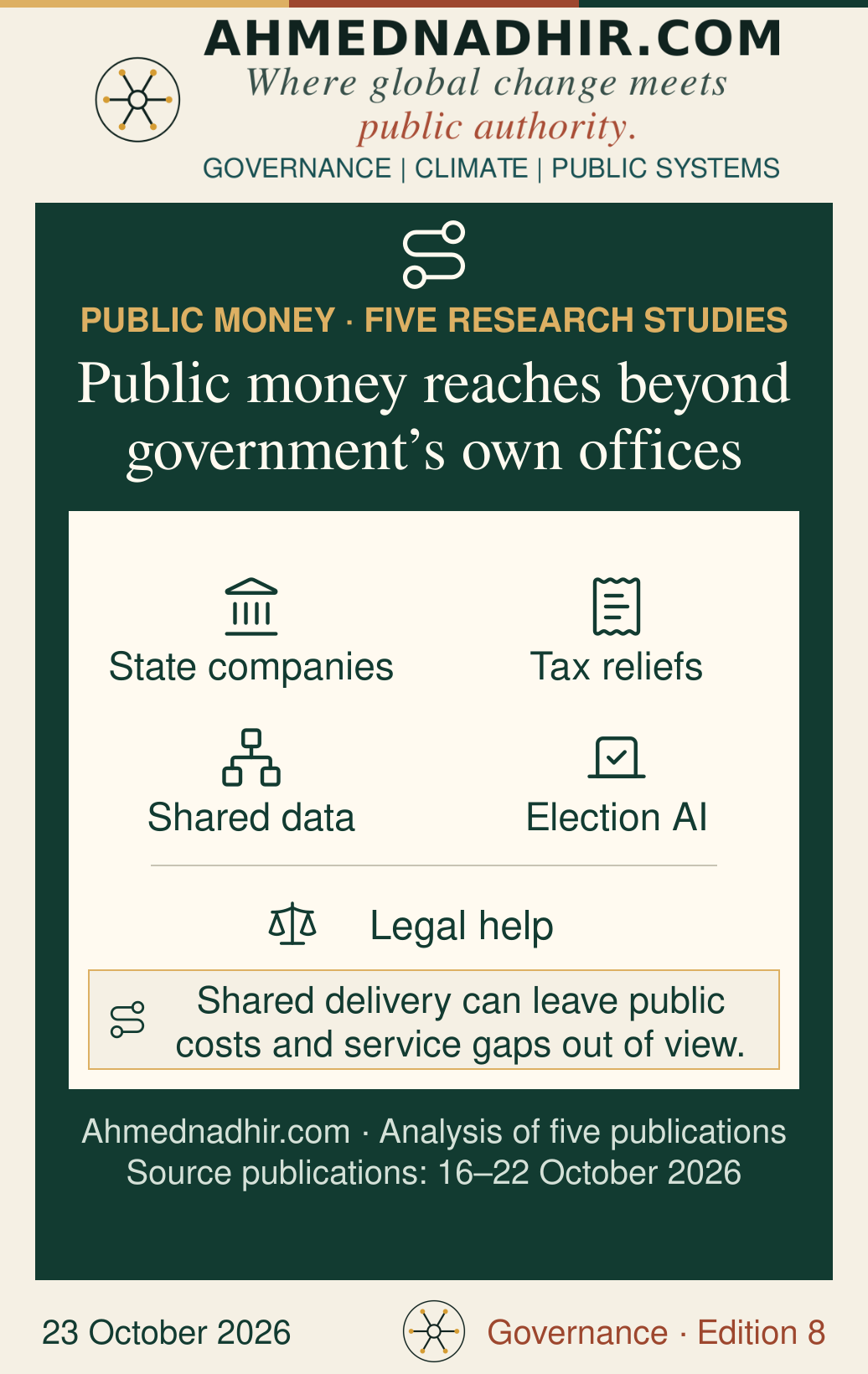
Five studies connect the costs of tax reliefs and public companies with funding for shared data, expertise in election technology and access to legal advice.
In this week’s edition
The five publications were issued from 16 to 22 October 2026. Four come from the Organisation for Economic Co-operation and Development (OECD), and one from the United Nations Development Programme (UNDP). Their evidence ranges from company records and comparative policy analysis to case studies and institutional surveys.
Public work across institutions
The costs behind a service delivered through others
A public company may be asked to keep a service affordable. A tax relief can support a business without a payment appearing in the spending budget. A shared data platform must still pay for staff and support when its launch grant ends. These arrangements change where public costs appear and how people experience the service.
The analysis follows the costs behind each arrangement and the service at the other end: a reliable utility, a usable data exchange or advice that reaches the person seeking it. The research accounts report the publications’ findings; the geographical readings and synthesis are Ahmednadhir.com’s analysis.
Five settings in which public costs and service gaps can fall between institutions.
The OECD combines a policy comparison covering 58 economies with a new global company dataset. Approximately 33,800 large state-owned enterprises held USD 141 trillion in assets in 2024. Within the policy comparison, only 48% of countries link compensation for public-service obligations directly to costs and require separate accounts. The report examines ownership mandates, boards, disclosure and public support. Its central governance distinction separates the state’s role as owner from its regulatory and policy roles, while making public service obligations and their funding explicit.
The governance reading
Kenya
Where a county owns a service company, the useful question is what the public owner expects it to deliver and how the board can be held to that mandate. An affordable service requirement needs a credible account of its cost. Otherwise financial results become difficult to interpret, and operational decisions can be drawn back into political offices without a clear allocation of responsibility.
Global South
Public enterprises may carry essential infrastructure and social obligations in economies with limited alternatives. Transparent funding allows governments to distinguish a deliberate subsidy from an unexplained loss. Governance reform therefore needs to examine the service being purchased as well as commercial performance.
Wider world
The growth of state ownership makes the separation of ownership, regulation and enterprise management consequential for competition and public confidence. Comparative evidence can inform those arrangements, but a common ownership model will not fit every sector or jurisdiction.
Cost-linked public-service compensation and separate accounts in the country policy comparison.
A public owner needs a visible mandate, a capable board and an explicit account of the services it funds.
Tax expenditures pursue policy objectives through departures from the ordinary tax system, including reliefs and exemptions, rather than a direct spending payment. The OECD examines how Canada, Ireland, the Netherlands and the United Kingdom manage them within national budgeting. The paper compares six dimensions of practice and identifies ways to bring these measures more fully into budget decisions.
The governance reading
Kenya
For Kenya’s budget debate, the important comparison is between different ways of supporting the same public objective. A national tax concession and a county revenue waiver involve distinct decisions and powers, but both raise questions about purpose, estimated cost and the evidence expected in return. A visible review date helps prevent an initial justification from becoming a permanent substitute for assessment.
Global South
Governments seeking investment face pressure to offer concessions while needing revenue for services. A credible account of beneficiaries and fiscal cost can make that negotiation more informed. Administrative capacity also matters: a complicated relief may be difficult to claim and expensive for the revenue authority to verify.
Wider world
Budget scrutiny is incomplete if it examines direct grants closely while treating forgone revenue as costless. Comparable information on objectives and results can improve the choice between instruments without assuming that a grant and a tax relief produce identical effects.
Two funding instruments, one public objective. Editorial comparison.
The funding instrument should not determine whether its public cost receives scrutiny.
A data space allows organisations to share information under common rules while retaining meaningful control over its use. Reviewing more than 200 initiatives, the OECD finds that few have achieved both operational and financial viability. It contrasts cases with an early, demonstrable use for the shared data with arrangements unable to sustain participation after grant funding ended. The problem concerns incentives and continuing governance as well as technology.
The governance reading
Kenya
For a partnership involving ministries, counties or service providers, building a platform differs from sustaining the exchanges that make it valuable. Participants need a defined service problem, workable permissions and a fair account of continuing costs. County teams also need a practical voice in changes to the rules if they supply the records on which the system depends.
Global South
Externally financed platforms can leave local organisations paying for data preparation, connectivity and support after the initial grant. A viable arrangement needs to return usable benefits to the institutions providing information. Digital sovereignty includes the ability to set terms, refuse a use and continue a service when funding changes.
Wider world
Shared systems can support artificial intelligence and cross-border services without placing all data under one intermediary. Their legitimacy and durability depend on agreed rights and benefits, alongside technical connections.
Two cases connect continuing finance with useful exchanges.
Continued participation depends on value that members can recognise and finance.
AI in electoral administration
Election software needs expertise inside the authority
UNDP examines how electoral management bodies use, prepare for and govern artificial intelligence (AI). The analysis draws on a 2026 survey of 53 bodies across six regions, alongside desk research and conference contributions. It considers electoral functions together with procurement, institutional readiness, inclusion, information integrity and cybersecurity, placing the proposed tool within the institution responsible for its use.
The governance reading
Kenya
For Kenya, the question is institutional control over a proposed administrative use. The electoral authority needs staff who can specify the task, examine supplier evidence and understand how an error would be detected and addressed. Clear conditions for permitted uses and a route for human review would help connect the purchase of a system to the authority’s responsibility for the service.
Global South
Supplier dependence can become acute where local technical capacity and procurement resources are limited. Language coverage, accessibility and the ability to inspect system changes deserve attention alongside purchase price. Domestic capability includes people able to judge whether a tool is appropriate, even when the software comes from elsewhere.
Wider world
Electoral administration combines technical operations with decisions requiring legal authority and public legitimacy. A supplier’s performance claim cannot settle the acceptability of a use or replace the institution’s explanation. These are governance implications of the analysis, rather than measured effects reported by the survey.
The institutional and regional coverage of the survey, not an outcome measure.
The electoral body needs the capability to judge the tool and answer for its administrative use.
Access to justice
People need help between a legal problem and its resolution
The OECD assesses justice through people’s problems, the help they obtain and the outcomes they report, alongside institutional policies. Among people needing personalised assistance or advice, the median country-level rate of obtaining it is 38%. The report argues for better connections between information, tailored advice and appropriate resolution services, while protecting the distinct roles and independence of the institutions involved.
The governance reading
Kenya
For a resident facing a land, employment or administrative problem, knowing an office’s name may be only the beginning. A county service desk can make a useful referral while recognising the responsibilities of courts, legal aid providers and other competent bodies. The governance question is whether the person reaches appropriate help, beyond the first office recording the matter as referred.
Global South
Distance, cost, language and limited professional advice can prevent a formal right from becoming a usable remedy. Community providers and public services may help connect people to assistance where their roles and referral relationships are clear. Digitising a form does not resolve the absence of someone able to advise the person completing it.
Wider world
Caseloads and processing times miss people who never enter a formal institution or abandon the process. Evidence about unmet legal needs can therefore change resource allocation and the definition of successful service. The comparison establishes a baseline for learning rather than a causal verdict on one reform.
Advice obtained among people who needed it, expressed as a country median.
A referral becomes useful when the person can reach appropriate assistance and understand the next step.
The governing question
Public costs and service gaps can fall between institutions
The public cost can sit outside the line most people inspect. A company may carry the expense of a service obligation; a tax concession reduces revenue instead of recording a grant; a data partnership keeps generating bills after its start-up support ends.
Service records can be incomplete in a similar way. Purchasing election technology does not establish that the authority has the expertise to assess it. Recording a justice referral does not establish that the person received advice. These are different tests and require different evidence.
The practical value of the research is to connect financial and institutional records with the service being delivered. Clear accounts, capable staff and follow-up help explain a subsidy’s purpose, a platform’s continuing value and whether a person referred for advice actually received it.
Reflections for policy work
Three questions to carry into the institution
Who can change the arrangement?
When the public objective is not being met, which institution has the information and authority to alter the mandate, contract, rules or service pathway?
Which costs remain public?
Are forgone revenue, service subsidies, data preparation, continuing support and referral capacity visible in the decision about how the work will be financed?
Where can a person seek an answer?
Can someone affected identify a body that will examine the concern and explain its response, rather than pass responsibility between organisations?
Original publications
Sources and publication dates
The research accounts report the publications’ claims. The governance readings, interpretive diagrams and synthesis are Ahmednadhir.com’s analysis. The sources differ in method and reach; their findings do not establish a common measured effect on public services.